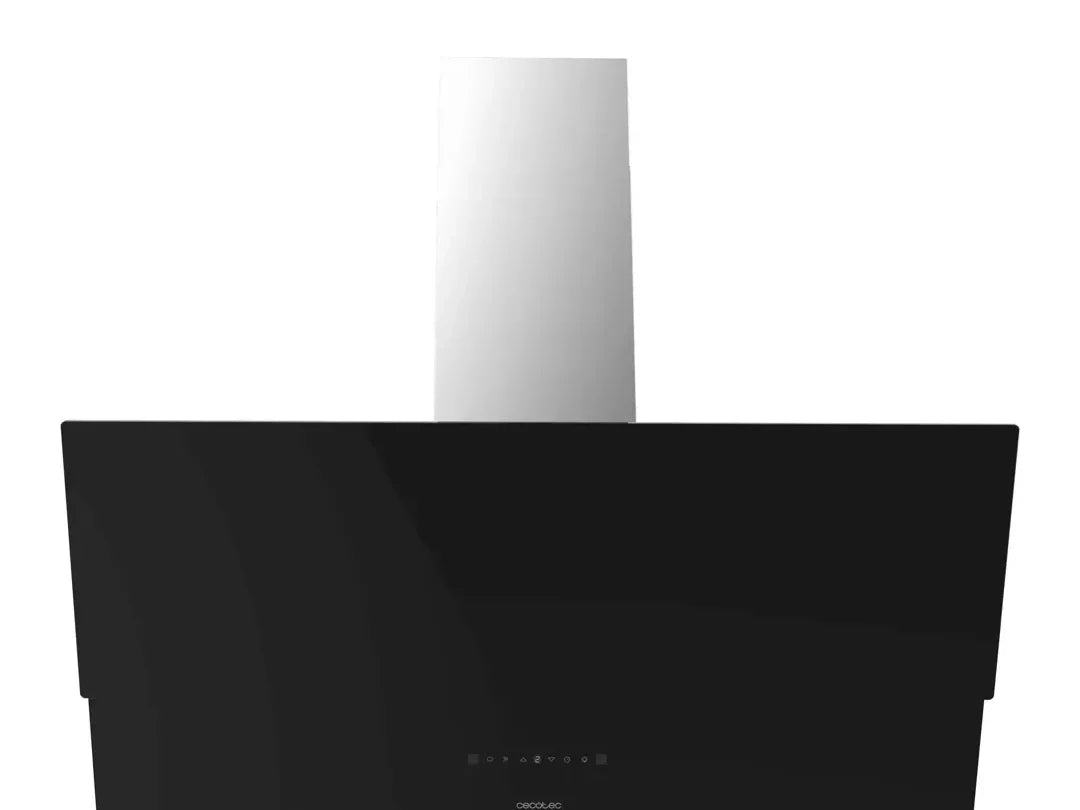
A range hood is the appliance that draws in the smoke, vapors, grease, and odors generated by cooking to expel them outside or filter them and return clean air to the kitchen. Its capacity is measured in cubic meters per hour (m³/h), and they come in decorative, island, built-in, and even downdraft models integrated into the cooktop itself.
Choosing a hood seems simple until you're standing in front of the catalog: power levels ranging from 220 to over 800 m³/h, widths of 60 or 90 cm, black or white glass or stainless steel versions, touch or gesture control… and a detail that almost no one checks and that changes everything: noise. In this guide, we provide clarity with real data from the Merkimarket range hood catalog so you get it right the first time. All references cited correspond to models available in the store.
Key facts before choosing
- Power unit: suction flow rate is expressed in m³/h; the higher the m³/h, the greater the capacity to "clean" the kitchen air.
- Quick rule: multiply the volume of your kitchen (length × width × height) by 10-12 air changes per hour to find the minimum m³/h you need.
- Main types: decorative (wall-mounted), island, built-in or telescopic (under-cabinet), and integrated into the cooktop.
- Two operating modes: extraction to the outside (ideal) or recirculation with activated carbon filters.
- Standard widths: 60 and 90 cm; the hood must be at least as wide as the cooktop.
- Energy efficiency: classes ranging from B to A++ coexist in the catalog; the label influences actual consumption.
- Noise matters: it is measured in decibels (dB(A)) and makes the difference between a hood you will use and one you will avoid turning on.
Now that you have the map, let's break it down.
How much m³/h you really need
This is the first and most important question, because a hood with low power won't eliminate odors no matter how beautiful it is. The calculation is simple: measure your kitchen, get its volume in cubic meters, and multiply it by the number of recommended air changes per hour.
- Calculate the volume: length × width × height of the room. For example, a 3 × 2.5 × 2.7 m kitchen is about 20 m³.
- Apply the air changes: 10 to 12 changes per hour are recommended for closed kitchens. 20 m³ × 12 = 240 m³/h minimum.
- Add a margin if you cook a lot or have an open kitchen: for kitchens open to the living room or with heavy use, increase to 15 changes. And if you work in recirculation mode, account for 30-40% more flow rate because the air passes through the carbon filter.
Translated to the catalog: for a small, well-ventilated kitchen, a 350 m³/h model may suffice, while for a large or open kitchen, it is best to aim for 650-800 m³/h. The 60 cm black glass hood with 800 m³/h suction and class A++ is a good example of ample power for the average Spanish home.

Types of range hoods
Beyond power, the type determines where and how it is installed. These are the families you will find:
| Type | Description | Best for | Typical widths |
|---|---|---|---|
| Decorative (wall-mounted) | Visible, wall-attached, in glass or steel | The most common option; when the hood is also decorative | 60 and 90 cm |
| Island | Ceiling-mounted above a kitchen island | Kitchens with the cooking area in the center | 38-90 cm |
| Built-in / telescopic | Hidden under a high cabinet, pulled out for use | Those looking for discretion and maximum space usage | 60 cm |
| Integrated into cooktop | Suction is incorporated into the induction hob itself | Design-focused kitchens with no visible hood | 80 cm (hob) |
Decorative models are the stars of the catalog, with black glass, white glass, and stainless steel finishes. Island hoods, such as the 38 cm models with carbon filters, resolve kitchens with a peninsula or central island. And for those who don't want to see the hood, induction-integrated suction—like the TotalFlex80 induction hob with integrated hood—extracts vapors directly from the cooking surface.

Extraction or recirculation: the decision that changes the filter
Every hood works in one of these two ways, and choosing correctly saves you trouble:
Extraction (vented out). The laden air is expelled outside the home through a duct. This is the most effective mode because it truly removes humidity, heat, and odors. It requires an evacuation pipe leading to an exterior vent or a ventilation shaft.
Recirculation (filtered). When no exterior vent is possible, the hood filters the air with activated carbon filters and returns it to the kitchen. It is the solution for apartments without a duct, although it is slightly less effective against humidity and requires replacing the carbon filters every few months. Many models in the catalog are suitable for both modes and are supplied ready for recirculation.
A practical note: the metal filters that trap grease are washable and, in most hoods, dishwasher safe. Carbon filters, however, cannot be washed: they must be replaced.
Noise: the data almost no one looks at
A powerful hood that sounds like a hairdryer will end up being turned off. Noise is measured in A-weighted decibels (dB(A)) and increases with suction speed. As a guide, at the minimum speed, a domestic hood usually runs around 45-55 dB(A), while at maximum power or with the booster function activated, it can exceed 65 dB(A).
| Noise level | Perception | Recommended use |
|---|---|---|
| 45-55 dB(A) | Quiet conversation | Low speeds, everyday cooking |
| 55-65 dB(A) | Noticeable background noise | Medium speed, steaming |
| Over 65 dB(A) | Loud, annoying long-term | Occasional booster for frying or heavy smoke |
The useful takeaway is this: look for a hood that gives you the flow rate you need without having to always run it at maximum speed. This way, you will work in the quiet range most of the time and reserve the booster for moments with heavy smoke.
Energy efficiency and consumption
Like other appliances, hoods have an energy label, and classes ranging from B to A++ coexist in the catalog. The difference is mainly determined by the motor and lighting: A++ models feature more efficient motors and low-consumption LED lighting, which also lasts much longer than older halogens. If you want to understand exactly what that label measures, our guide on how to read the energy label will help you.
The stainless steel class A++ hood with booster function is an example of this balance: high power when you need it and contained consumption during daily use.

Dimensions and cooktop compatibility
The golden rule: the hood must be at least as wide as the cooktop. If your hob is 60 cm, the hood should not be smaller than 60 cm; if you have an 80-90 cm hob or cook a lot over high heat, get a 90 cm model, which "captures" smoke better at the sides. Regarding installation height, manufacturers usually recommend between 65 and 75 cm above an induction or ceramic hob, and slightly more above gas. Placing it too high reduces efficiency; too low, it gets in the way and gets dirty faster.
If you are renovating the entire kitchen, it is worth thinking about the hood along with the rest of the appliances and the layout. Our guide on modern kitchens: styles, layout, and materials gives you the context so everything fits.
How to choose your range hood in 5 steps
- Calculate the m³/h. Kitchen volume × 10-12 changes (×15 if it is open or you are using recirculation). That is your minimum flow rate.
- Decide the mode. Do you have an exterior vent? Extraction. Don't have one? Recirculation with carbon filters.
- Choose the type and width. Decorative, island, built-in, or integrated into the cooktop; and never narrower than your hob.
- Check noise and efficiency. Prioritize models that provide your required flow rate at intermediate speeds and have a good energy class (A or higher).
- Finalize the finish. Black glass, white glass, or stainless steel to match the hob and the rest of the kitchen.
Ready to compare models? Go to the full range hood catalog and filter by width and power. And if your project includes changing the cooktop as well, you might be interested in the comparison of induction, ceramic, or gas hobs.
Frequently asked questions about range hoods
How many m³/h does a range hood need?
Multiply your kitchen volume (length × width × height) by 10-12 changes per hour. A 20 m³ kitchen requires about 240 m³/h minimum; in open kitchens or recirculation mode, it is advisable to increase the flow rate by 30-40%.
Which is better, an extraction or a recirculation hood?
Extraction to the outside is more effective because it expels humidity, heat, and odors from the home. Recirculation with carbon filters is the alternative when there is no outlet duct, although it requires replacing those filters every few months.
How many decibels does a quiet hood produce?
At low speed, a domestic hood is usually around 45-55 dB(A). Ideally, choose one that gives you the necessary flow rate without always reaching maximum speed, reserving the booster (above 65 dB(A)) for specific moments.
Does the hood have to be the same width as the cooktop?
At a minimum. For a 60 cm hob, a 60 cm hood; if you have an 80-90 cm hob or cook a lot, a 90 cm one captures smoke better. Never choose a hood narrower than the cooking area.
Article written by the Merkimarket editorial team. Technical data (power, dimensions, finishes, and energy classes) taken from the Merkimarket range hood catalog datasheets. Price ranges and availability may vary; check each datasheet for current information in Spain.