

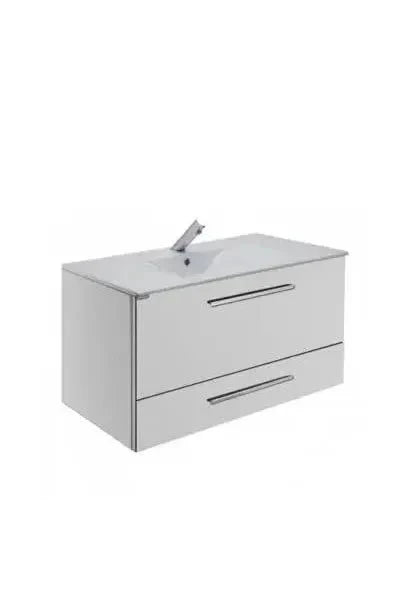
Bathroom vanities are storage units —usually with an integrated sink— that organize the washbasin area. They are manufactured in MDF, particle board, or porcelain, installed either wall-mounted or on a pedestal, and come in widths from 40 to 120 cm with finishes such as white, beech, cuzco, or glossy black.
Choosing a bathroom vanity is one of those decisions that seems simple until you start measuring: the width of the wall, the height of the drain, how many drawers you really need, and which material will withstand years of humidity. This guide organizes everything that matters —types, dimensions, materials, and storage— so you get it right the first time. The technical data and sample measurements are taken from the Merkimarket bathroom vanity catalog, featuring real models from the Unisan brand.
Key facts about bathroom vanities
- What they are: storage sets for the sink area, with or without an integrated washbasin.
- Installation types: wall-mounted (anchored to the wall), floor-standing on a pedestal, and with a countertop for drop-in or vessel sinks.
- Common widths: from 40 cm for small half-baths to 120 cm with a double basin for large bathrooms; 60 and 80 cm are the best-selling sizes.
- Materials: MDF and water-repellent particle board for the body; porcelain and cork in pedestal models.
- Finishes: white, beech, cuzco (light wood), gray, and glossy black, in addition to children's lines like WCKids.
- Installation height: the top surface of the sink is usually placed 85-90 cm from the finished floor.
- Warranty: the three-year legal minimum for consumers in Spain against lack of conformity, plus the seller's commercial warranty.
With this, you have the map; below we develop each point so you can decide with criteria.
Types of bathroom vanities by installation
The first decision is not the color or size, but how the vanity is mounted, because it determines the construction work, cleaning, and the sense of spaciousness in the bathroom.
Wall-mounted. This is the most requested today. It is anchored to the wall and leaves the floor free underneath, which provides visual lightness and facilitates cleaning (it does not accumulate dirt on the baseboard). It requires a wall in good condition that can support the weight of the vanity plus the sink filled with water. Most of the catalog —series like Denia, Alicante, Flat, or Join— is wall-mounted.
With countertop. Here the vanity provides the base and the countertop, and you choose the sink: drop-in (recessed into the countertop) or vessel (resting on top, bowl-style). It offers great aesthetic flexibility and allows for designer sinks, but requires good height coordination so you don't end up with the faucet too high or too low.
Floor-standing or pedestal. The unit rests on the floor. It is the easiest option to install when the wall does not support load-bearing anchors, and in compact formats (like the 45 cm Round model in porcelain and cork) it solves the needs of very small powder rooms without construction.

Dimensions: width, height, and depth
Measuring well is what separates a perfect purchase from a return. There are three dimensions you should note before anything else.
Width. This is the deciding measurement. The catalog includes everything from 40 cm (ideal for powder rooms, like the children's WCKids model) to 120 cm with double basins for master bathrooms, as well as the classic 60, 63, 65, 83, 90, and 100 cm. As a practical rule, leave at least 5-10 cm of clearance on each side of the vanity relative to the wall or door.
Installation height. In a wall-mounted vanity, you decide the height when you anchor it. The comfortable reference is to leave the upper edge of the sink about 85-90 cm from the finished floor; if there are very tall or short people in the house, adjust it to their height, as this is one of the great advantages of the wall-mounted type.
Depth. This is the dimension most people forget and the one that causes a door not to open or the vanity to obstruct the walkway. Check the depth of the vanity and add the protrusion of the faucet; in narrow bathrooms, a reduced depth makes a difference.
Materials: which withstands humidity best
A bathroom is the most hostile environment in the house for furniture: steam, splashes, and constant temperature changes. These are the materials you will see and how they perform.
| Material | Where it is used | Advantages | Keep in mind |
|---|---|---|---|
| MDF (fiberboard) | Body and fronts of most vanities | Smooth and homogeneous surface, good lacquered finish, stable | Requires good edge sealing against humidity |
| Particle board | Structure of series like Denia | Resistant and economical, good value for money | Choose the water-repellent version and take care of the edges |
| Porcelain | Sink and pedestal sets (Round) | Waterproof, hygienic, and very easy to clean | Heavier and fragile against strong impacts |
| Cork | Details and bases in designer models | Warm, lightweight, and sustainable | Decorative finish, not structural |
The practical conclusion: a body made of water-repellent MDF or particle board with well-sealed edges is standard and works well if you respect maintenance; porcelain is unbeatable for the sink itself due to its impermeability. Beware of fronts that swell at the bottom: it is almost always water filtered through a poorly finished edge.

Storage: drawers, doors, and interior organization
A bathroom vanity is not just about aesthetics: it is square footage for storage in a space where there is never enough room. When comparing, look beyond the front.
Drawers vs. doors. Drawers make better use of depth and give you access to everything at a glance, ideal for hairdryers, cosmetics, and hand towels. Doors perform well for tall items (cleaning supplies, paper) and usually lower the total cost. Many models combine both: a wide upper drawer and a cabinet with a door below.
The siphon cutout. In vanities with an integrated sink, part of the interior space is occupied by the drain. Well-designed models cut out just enough space or use U-shaped drawers to avoid losing capacity; it is a detail that is appreciated every day.
Slides and hinges. Slides with soft-close mechanisms and quality metal hinges are what distinguish a vanity that ages well from one that starts having sagging doors after a year. When buying, open and close them mentally: it is the piece that gets used the most.
How to choose your bathroom vanity in 5 steps
- Measure the actual space. Note the available width, depth, and the position of the drain and water intake. Subtract the side clearance and you have the maximum vanity width.
- Decide on the type of installation. Wall-mounted if the wall can hold it and you want visual spaciousness; floor-standing or pedestal if you are looking for simple assembly or the wall does not support a load.
- Choose the sink. Integrated for maximum simplicity, or a vanity with a countertop if you prefer a drop-in or vessel sink to your taste.
- Prioritize the storage you use. Drawers if you accumulate cosmetics and towels; doors if you store tall items. Check how the siphon cutout is resolved.
- Finalize the finish. White for brightness and neutrality; beech or cuzco for warmth; glossy black for character. Matching the faucet and mirror completes the set.

Maintenance: make it last like the first day
Bathroom furniture requires few gestures but consistent ones. Dry splashes on the surface and, above all, the base next to the trim, which is where water accumulates. Clean with a soft cloth and neutral soap; avoid abrasives and excess direct water on the edges. Ventilate the bathroom after showering to lower ambient humidity: it is the silent enemy of any board. And check the siphon and connections once a year; a micro-leak you don't see is what ends up swelling the wood from the inside.
Coordinate the vanity with the rest of the bathroom
The vanity sets the style of the bathroom, but it doesn't live alone. Coordinate its finish with the faucets (see our guide on bathroom faucets and finishes) and with the type of sink you mount on top; if you are in doubt between formats, it will help to review the types of sinks. And if the vanity is part of a larger renovation, plan the phases well with the guide on how to renovate the bathroom so that everything arrives in the correct order.
Ready to see it in product? Explore the complete catalog of bathroom vanities or check out two popular references to get an idea of sizes and finishes: the 100 cm Denia wall-mounted vanity and the Alicante vanity in white MDF.
Frequently asked questions about bathroom vanities
What size bathroom vanity do I need?
It depends on the free width of your wall. Measure the space, subtract 5-10 cm of clearance on each side, and choose from the available formats: 40 cm for powder rooms, 60-65 cm for medium bathrooms, and 90-120 cm (often with double basin) for master bathrooms.
Is a wall-mounted or floor-standing vanity better?
The wall-mounted type wins in visual spaciousness and cleanliness because it leaves the floor free, and allows you to adjust the sink height; it needs a wall that can support the load. The floor-standing or pedestal type is easier to install and a good option when the wall does not support anchors.
Which material best withstands bathroom humidity?
For the body of the vanity, water-repellent MDF and particle board with well-sealed edges work well with reasonable maintenance. For the sink, porcelain is practically unbeatable for being waterproof and hygienic.
At what height is a wall-mounted bathroom vanity installed?
The comfortable reference is to leave the upper edge of the sink about 85-90 cm from the finished floor. Since it is wall-mounted, you can adapt that height to the stature of those who use it, which is one of its great advantages.
Article written by the Merkimarket editorial team. Measurements, materials, and finishes taken from the sheets of the Merkimarket bathroom vanity catalog (Unisan brand). Size ranges, availability, and prices may vary; check each sheet for the current information in Spain.





