

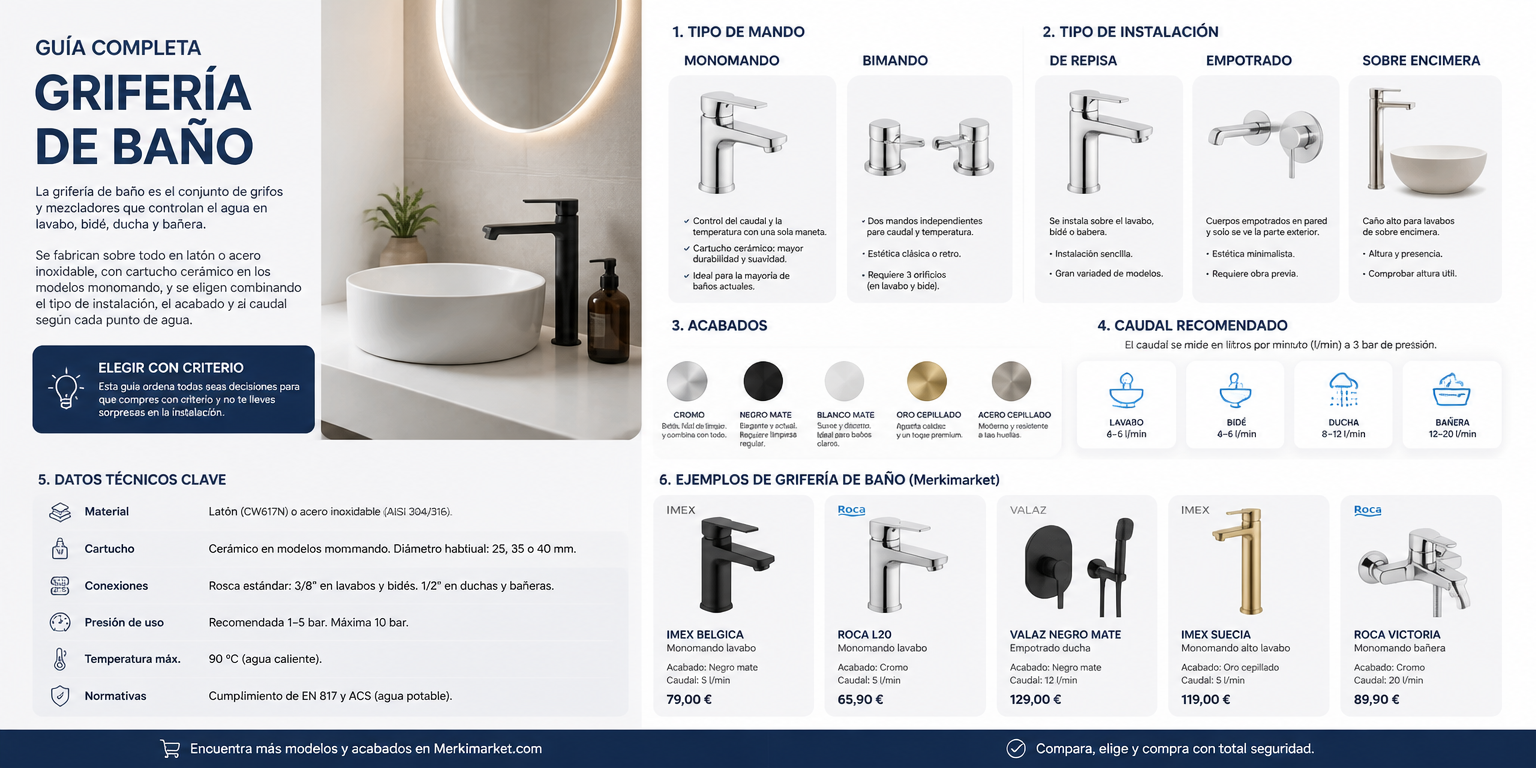
Bathroom faucets are the set of taps and mixers that control water in the sink, bidet, shower, and bathtub. They are primarily manufactured in brass or stainless steel, featuring ceramic cartridges in single-lever models. They are selected by combining the type of installation, the finish, and the flow rate for each water point.
Choosing bathroom faucets seems simple until you face the catalog: single-lever or dual-handle, deck-mounted or wall-mounted, chrome or matte black, high spout or standard. This guide organizes all these decisions so you can purchase with criteria and avoid any surprises during installation. The technical data and examples are taken from real product sheets of the Merkimarket bathroom faucet collection, featuring brands such as IMEX, Roca, GME, or Valaz.
Key facts about bathroom faucets
- Water points: sink, bidet, shower, and bathtub; each one requires a different type of faucet.
- Common materials: brass (the gold standard for resistance and weight) and stainless steel in areas of continuous humidity such as the shower.
- Internal mechanism: 25 or 35 mm ceramic cartridge in single-lever models; it is a replaceable part that extends the life of the faucet.
- Types of installation: deck-mounted (on the sanitary ware or countertop) and wall-mounted, with or without a recessed box.
- Finishes: chrome, matte black, brushed gold, rose gold, and gunmetal; the colored ones undergo PVD treatment.
- Water saving: cartridges with flow limiters and cold-start technology reduce consumption without you noticing.
- Warranty: a legal minimum of three years for consumers in Spain, plus the seller's commercial warranty.
With this summary, you now have the map; below, we develop each point so you can choose without making a mistake.
Types of bathroom faucets by area
The first criterion is not aesthetics, but the water point. Each area of the bathroom has its own faucet and they are not interchangeable:
Sink faucet. It is the most visible and the most used. There are low-spout models (standard) for inset sinks and high-spout models for countertop sinks, where the water must clear the height of the basin. Most are deck-mounted single-lever, although there are also wall-mounted versions that keep the countertop clear.
Bidet faucet. Similar to the sink faucet but with an adjustable spout and, often, a specific valve. If your bathroom has a bidet, it is advisable to choose one from the same series and finish as the sink to maintain consistency.
Shower and bathtub faucets. This includes exposed single-lever mixers —such as the Córcega single-lever bathtub mixer with hand shower—, shower columns with a showerhead, thermostatic bars, and recessed sets. This is the most demanding area due to humidity and temperature, which is why many models are manufactured in stainless steel.

Types of faucets by mechanism
Within each area, the faucet can function in several ways. Understanding the mechanism is what prevents that typical bad purchase:
Single-lever. A single handle regulates both flow and temperature. It is the current standard for convenience and for its ceramic cartridge, which barely drips. Ideal for sink and bidet.
Dual-handle (or mixer). Two independent knobs, one for cold water and one for hot. It has a classic air and fits into traditional or vintage-style bathrooms, such as some models from the Carmen series by Roca.
Thermostatic. Common in showers and bathtubs, it maintains the set temperature even if the water pressure changes. It provides safety against burns and extra comfort. If you want to delve deeper, we have a specific guide on how to choose modern bathroom faucets.
Recessed. The body of the faucet is hidden in the wall and only the handle and the spout are visible. It is the cleanest and most minimalist option, but it requires construction work and planning before tiling.
| Faucet type | How it works | Best suited for | Things to consider |
|---|---|---|---|
| Single-lever | One handle for flow and temperature | Sink and bidet | Convenience and ceramic cartridge |
| Dual-handle | Two knobs (cold and hot) | Classic bathrooms | Traditional aesthetics |
| Thermostatic | Sets a fixed temperature | Shower and bathtub | Safety and comfort |
| Recessed | Body hidden in the wall | Shower, designer sink | Requires prior construction |
Materials and cartridge: what you don't see
What separates a long-lasting faucet from one that leaks after a year isn't the photo; it's what's inside. Look at three things:
The body. Brass is the gold standard in bathroom faucets for its corrosion resistance and weight; a suspiciously light faucet often hides interiors made of zamak. In showers and some kitchen faucets, stainless steel is used, as it is more suitable for continuous humidity.
The cartridge. It is the heart of the single-lever faucet. Good models feature a 25 mm ceramic cartridge (sometimes 35 mm in high-flow faucets), which regulates water with a smooth feel and no leaks for thousands of uses. As it is a replaceable part, changing it brings the faucet back to new condition for very little money.
The aerator. That small grid at the tip of the spout mixes air with the water to provide a sensation of an abundant stream while using less. It is also where limescale accumulates first, so choose one that is unscrewable for easy cleaning.

Finishes: from classic chrome to matte black
The finish is the most noticeable decision at a glance and the one that defines the style of the bathroom. These are the most common options:
- Chrome: the neutral finish par excellence. It goes with everything, is easy to clean, and hides limescale. The safe bet.
- Matte black: very trendy in modern bathrooms; adds character, but shows water spots more and requires slightly more frequent cleaning.
- Brushed gold and rose gold: warm and elegant, they provide a design touch without looking cluttered thanks to the matte brushed effect.
- Gunmetal (graphite): a dark metallic gray, sophisticated and less common, perfect if you are looking for something different.
A practical tip: choose the same finish for the faucet, drain, and exposed trap. That detail of everything matching is what creates a cohesive look. If you are unsure about colors, our guide to combining finishes in the bathroom will help you decide.

Dimensions and installation height
Before buying, check two measurements. First, the spout height relative to your sink: for countertop sinks, you need a high faucet so the water falls comfortably into the basin. Second, the distance between the faucet and the bottom of the sink, to avoid splashing. For recessed faucets, you must also plan the connection in the wall before tiling. For the shower, the bar or column is usually installed between 1.10 and 1.20 m from the tray, although it is best to adjust it to the height of the user.
How to choose your bathroom faucets in 5 steps
- Start with the area. Make a list of the water points you are going to renovate (sink, bidet, shower, bathtub) and assign each one its type of faucet.
- Decide on the mechanism. Single-lever for sink and bidet; thermostatic for the shower if you value safety and comfort.
- Choose the finish and don't mix them. It is the decision that dictates the aesthetic: chrome to play it safe, matte black or gold if you are looking for character.
- Look at the interior. Brass or steel body, ceramic cartridge, and unscrewable aerator. That is where real durability lies.
- Close the deal with matching accessories. Click-clack drain valve and exposed trap in the same finish complete the set.
Ready to see the products? Explore all Merkimarket bathroom faucets or check out three popular references to get an idea of quality and finish: the Génova high-spout sink faucet in brushed gold, the Roca Carmen dual-handle faucet in chrome, and the GME Marriot single-lever faucet in white. And if you are renovating your entire faucet set, you might be interested in our definitive guide to IMEX faucets.
Frequently asked questions about bathroom faucets
Which is better, a brass or stainless steel faucet?
For sink and bidet, brass is the gold standard due to its resistance and weight. Stainless steel performs better in areas of continuous humidity like the shower. The important thing is to avoid faucets that are too light, which usually reveals interiors made of zamak.
How long does a bathroom faucet last?
A quality faucet with a ceramic cartridge can last for many years. When it starts to drip, it is almost always enough to replace the cartridge, an inexpensive part, instead of replacing the entire faucet.
Does a matte black faucet stain easily?
It shows limescale spots slightly more than chrome, but with a quality PVD treatment and regular cleaning with a soft cloth, it remains perfect. Avoid abrasive products.
What is the warranty for bathroom faucets in Spain?
Products sold to consumers are covered by a minimum legal warranty of three years against conformity defects, which the seller may complement with their own commercial warranty and spare parts.
Article written by the Merkimarket editorial team. Technical data (materials, cartridges, and finishes) taken from the product sheets of the Merkimarket bathroom faucet collection. Price ranges and availability may vary; check each product sheet for current information in Spain.





