Wall-hung toilets have become one of the defining features of modern bathroom design, and it's easy to understand why. With their sleek silhouette, floor-clearing installation, and the unmistakable sense of space they create, they've gone from being a niche luxury option to a mainstream choice for homeowners and interior designers alike.
But beyond their striking appearance, are wall-hung toilets the right choice for every bathroom — and every budget? In this comprehensive guide, we break down everything you need to know: what wall-hung toilets actually are, how they work, their real advantages and disadvantages, the technical requirements for installation, and the specific scenarios where they truly shine.
What Is a Wall-Hung Toilet?
A wall-hung toilet — also called a wall-mounted or floating toilet — is a toilet model where the ceramic bowl is fixed directly to the wall, with no floor contact whatsoever. The cistern (the tank that stores and releases the flush water) is completely concealed inside the wall within a specially designed metal frame called a carrier frame or in-wall cistern.
This setup is fundamentally different from a traditional close-coupled or back-to-wall toilet, where the cistern sits either directly on top of or immediately behind the bowl and is visible in the bathroom. With a wall-hung system, only the bowl and the flush actuator plate (a sleek panel on the wall) are visible — everything else is hidden behind the wall cladding or tile work.
The flush actuator plates come in a wide range of styles — from minimalist chrome squares to large-format glass or brushed stainless panels — and can be chosen to complement the overall design of the bathroom.
How Does a Wall-Hung Toilet Work?
The installation of a wall-hung toilet relies on a rigid steel or stainless steel carrier frame, which is bolted to the floor and/or the structural wall behind the finishing surface. This frame supports the full weight of the toilet bowl and the user — typically rated to bear loads of 400 kg or more in quality systems.
The in-wall cistern connects to the water supply and drainage behind the wall, with the flush pipe leading down into the ceramic bowl. The flush itself is operated via the actuator plate on the wall, which can be a push button, a touchless sensor, or even a dual-flush mechanism that allows you to choose between a partial flush (approx. 3 litres) and a full flush (approx. 6 litres), helping reduce water consumption significantly.
Once installed and tiled over, the entire mechanical system is invisible. Accessing the cistern for maintenance — such as replacing the flush mechanism or adjusting the water level — is done through a removable access panel that sits flush with the wall surface.
The Advantages of Wall-Hung Toilets
1. Modern, Minimalist Aesthetic
The most immediately obvious benefit of a wall-hung toilet is how it looks. Without a cistern, without floor contact, and with clean horizontal lines, a floating toilet transforms the visual dynamic of a bathroom. It creates an architectural quality that standard toilets simply cannot replicate.
For bathrooms with contemporary, Scandinavian, industrial, or luxury design schemes, a wall-hung toilet isn't just a functional element — it's a design statement. The visible floor space beneath the bowl adds to the sense of visual lightness and openness, making even compact bathrooms feel more deliberate and refined.
2. A Genuine Sense of Space
One of the most practical advantages of a wall-hung toilet is its ability to visually expand a bathroom, particularly smaller ones. Because the floor is entirely clear beneath the bowl, the eye perceives the room as larger and less cluttered than it actually is.
This is not just a visual trick — having unobstructed floor space also makes the bathroom feel more open in real terms. In tight city apartments or en-suite bathrooms where every centimetre counts, this effect can make a meaningful difference to how the space feels to live in day to day.
3. Dramatically Easier Cleaning
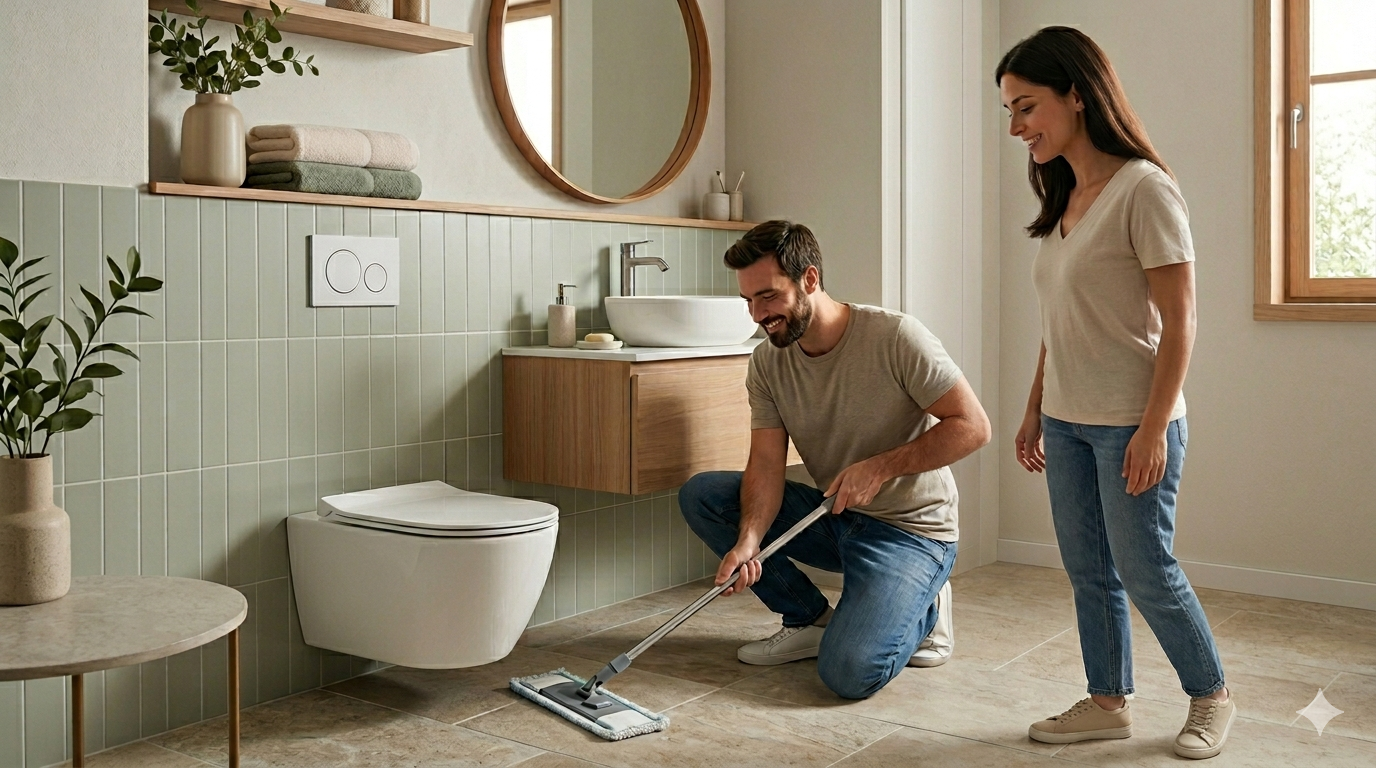
Traditional floor-mounted toilets are notorious for the awkward, hard-to-reach areas around their base — where the ceramic meets the floor, around the fixings, behind the pedestal — areas where dirt, dust, and moisture accumulate and are genuinely difficult to clean thoroughly.
A wall-hung toilet eliminates all of this. With the floor completely clear beneath the bowl, cleaning the bathroom floor becomes a straightforward task: you can mop or wipe the entire floor surface in a single movement, with no obstacles to navigate around. This hygiene advantage is particularly appreciated in households with children, in guest bathrooms, or in any environment where cleaning efficiency is a priority.
Additionally, because the cistern and pipework are enclosed behind the wall, there are no exposed water pipes or awkward junctions to harbour limescale or grime.
4. Customisable Height
One of the most underappreciated practical advantages of wall-hung toilets is that the installation height is fully adjustable during fitting. With a traditional toilet, the seat height is fixed by the manufacturer — typically around 40–43 cm from floor to seat.
With a wall-hung system, the carrier frame allows the bowl to be set at any height within a certain range — commonly between 38 cm and 50 cm from floor to seat. This flexibility is invaluable for households where a taller installation height would improve comfort for tall users, for people with reduced mobility or joint problems, or as a genuine accessibility feature for users who require a specific ergonomic height.
For family bathrooms shared by adults and children, or for homes where accessibility is a current or future consideration, this adjustability is a significant functional advantage.
5. Space Saving in Small Bathrooms
Although the in-wall frame requires the construction of a false wall (typically 10–15 cm thick), wall-hung toilets can actually save floor space in a bathroom compared to traditional models. This is because the cistern footprint is built into the wall rather than projecting into the room.
In very narrow bathrooms or toilet rooms where a traditional back-to-wall unit would restrict circulation space, moving the cistern into the wall structure can free up several centimetres of usable floor depth — a significant gain in tight spaces.
The Disadvantages of Wall-Hung Toilets
1. More Complex and Costly Installation
The most significant drawback of wall-hung toilets is the installation complexity and the associated cost. Unlike a traditional toilet, which can generally be installed or replaced by a competent plumber in a matter of hours, a wall-hung system requires:
-
Construction of a false wall or recess to house the carrier frame and cistern
-
Structural anchoring of the steel carrier frame to the floor and/or wall
-
Routing of water supply and waste pipework to the new positions
-
Tiling or plastering the false wall to a finished standard
-
Installation of the actuator plate flush with the tiled surface
This means that fitting a wall-hung toilet in an existing bathroom effectively requires a partial or full bathroom renovation. It is not a like-for-like swap with a traditional toilet. Labour costs are considerably higher, and the involvement of a tiler alongside a plumber is typically required.
2. Higher Initial Investment
The hardware itself — quality carrier frame, in-wall cistern, ceramic bowl, and actuator plate — costs more than a comparable traditional toilet. Entry-level wall-hung systems from reputable brands start at a meaningful premium over a standard close-coupled toilet of equivalent ceramic quality.
However, it's worth contextualising this: when the full cost of a bathroom renovation is considered, the incremental additional cost of choosing a wall-hung over a traditional toilet is relatively modest. If you are already retiling, replumbing, or fully renovating a bathroom, the additional investment to go wall-hung is proportionally small.
3. Maintenance Requires More Planning
While day-to-day cleaning is easier with a wall-hung toilet, accessing the internal cistern for maintenance or repair requires a degree of pre-planning at installation stage. The access panel must be designed into the wall finish in a way that allows removal without damaging the surrounding tiles.
In bathrooms where this access has been thoughtfully designed — with a dedicated access panel that can be unclipped cleanly — maintenance is straightforward. In bathrooms where this has been overlooked, accessing the cistern can be more disruptive.
Quality carrier frame systems from established manufacturers include well-designed access solutions, which is one reason why investing in a reputable brand is particularly important for wall-hung installations.
4. Not Suitable for All Walls
Wall-hung toilets require a solid structural surface capable of anchoring the carrier frame securely. Lightweight partition walls, timber stud walls, or thin partition panels are not suitable without additional structural reinforcement. A structural assessment may be needed in some installations, particularly in older buildings or unconventional construction types.
When Should You Choose a Wall-Hung Toilet?
📏 Small Bathrooms and Toilet Rooms
If you have a compact bathroom or a dedicated WC where floor space is precious, a wall-hung toilet is an excellent choice. The clear floor, the concealed cistern, and the visual lightness it creates are particularly impactful in small spaces.
🎨 Modern or High-End Bathroom Renovations
For any renovation where design and aesthetics are a priority — contemporary, minimalist, luxury, Japandi, or architectural interiors — a wall-hung toilet delivers a finish that is simply not achievable with traditional floor-standing models.
🧼 Hygiene-Focused Environments
For households that place a premium on hygiene and cleaning ease, the absence of floor contact and concealed pipework makes a wall-hung toilet a genuinely practical choice beyond its aesthetics.
♿ Accessibility and Ergonomic Needs
For users who benefit from a higher seat height — older adults, taller individuals, people with hip or knee conditions — the adjustable installation height of a wall-hung toilet offers a level of personalisation that traditional toilets cannot match.
🏗️ Full Bathroom Renovations
Since installation requires construction work regardless, the ideal time to fit a wall-hung toilet is during a full bathroom renovation when walls, floors, and plumbing are already being opened up. Retrofitting a wall-hung toilet in an otherwise finished bathroom is significantly more disruptive and costly.
Wall-Hung vs. Traditional Toilet: A Practical Comparison
|
Feature |
Wall-Hung Toilet |
Traditional Toilet |
|
Aesthetic |
Minimalist, modern |
Classic, varied |
|
Floor cleaning |
Very easy |
More difficult |
|
Installation |
Complex, requires renovation |
Simple, standard |
|
Initial cost |
Higher |
Lower |
|
Height adjustability |
Yes, fully flexible |
Fixed |
|
Maintenance access |
Requires access panel |
Direct access |
|
Space perception |
Larger feel |
Standard |
|
Best for |
Renovations, modern design |
Straightforward replacement |
Conclusion: Is a Wall-Hung Toilet the Right Choice for Your Bathroom?
Wall-hung toilets represent a genuine upgrade in both form and function — but they are not the right choice for every situation. They shine in full bathroom renovations, in spaces where design is a priority, in smaller bathrooms where every visual centimetre matters, and for users who benefit from an adjustable seat height.
The investment they require — both financial and in terms of installation complexity — is real, but for the right project and the right bathroom, the result is a space that looks better, cleans more easily, and functions more comfortably for years to come.
At Merki Market, our collection of wall-hung toilets covers a wide range of styles, sizes, and price points — from understated matte-white ceramic to bold designer pieces — all with the technical specifications and carrier frame compatibility information you need to make a confident, informed purchase.
💡 Before purchasing, always confirm that your bathroom structure can accommodate a wall-hung installation. Consult with a qualified plumber or contractor to assess the suitability of your walls and the scope of work involved.
Explore our full collection of wall-hung toilets at Merki Market and find the model that transforms your bathroom into the space you've always envisioned.