

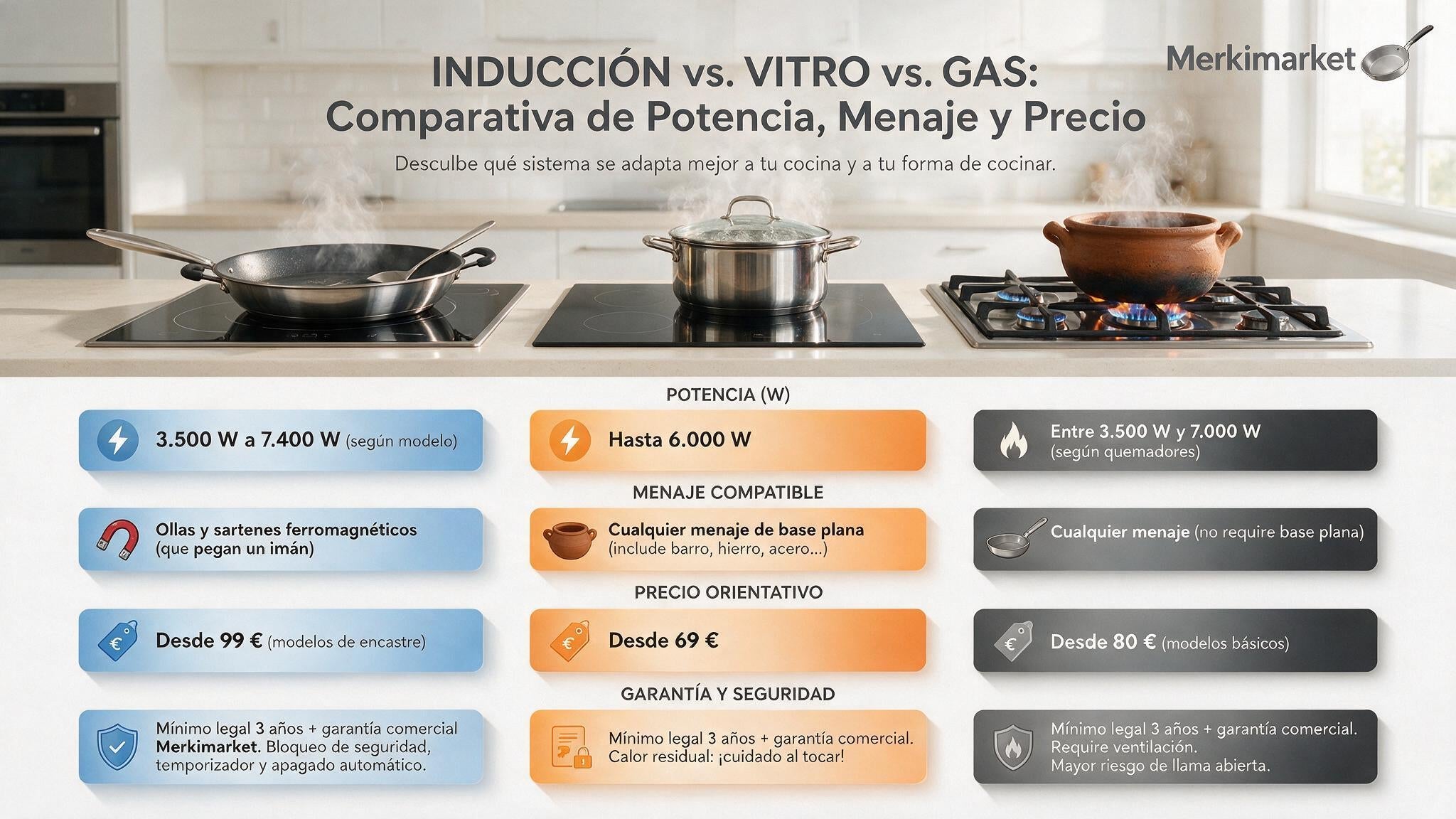
An induction cooktop heats the cookware directly via an electromagnetic field and is the technology with the highest energy efficiency; a ceramic hob uses radiant heating elements under glass and accepts any flat-bottomed cookware; a gas cooktop uses a direct flame and works without electricity. For most kitchens in Spain today, induction is the fastest, safest, and most efficient option.
Choosing between an induction, ceramic, or gas cooktop is one of the decisions that most affects day-to-day life in the kitchen: it impacts cooking time, energy consumption, safety, and even the cookware you can use. In this comparison, we get straight to the point with real-world criteria and examples taken from the Merkimarket kitchen catalog, so you can decide based on data rather than habit. All power figures, features, and indicative prices come from actual product data sheets available in the store.
Key data at a glance
- Induction: heats only the base of the cookware via electromagnetism; it is the fastest and most efficient (approx. 85-90% efficiency).
- Radiant ceramic: electric heating elements under ceramic glass; compatible with any flat-bottomed cookware, but slower and with residual heat.
- Gas: direct flame adjustable instantly; works without electricity, though with lower efficiency and a need for ventilation.
- Cookware: induction requires ferromagnetic cookware (that can hold a magnet); ceramic and gas accept almost any pot or pan.
- Actual power (catalog): induction cooktops from 3,500 W to 7,400 W and ceramic hobs up to 6,000 W, with touch control, timer, and safety lock.
- Indicative price: ceramic hobs from about €69, built-in induction from about €99, and models with integrated hoods over €800.
- Warranty: statutory minimum of three years for consumers in Spain, plus the seller's commercial warranty.
How each technology works
Induction. Under the glass, there is a coil that generates an electromagnetic field. That field induces currents in the ferromagnetic base of the cookware, and the pot itself is what heats up; the glass only warms up through contact. That is why the response is almost instantaneous and the heat disappears as soon as you remove the pot. Models like the Cecotec Bolero Squad I series include Flex and Bridge zones (which combine several zones for large cookware), a booster function to boil in seconds, touch control, and child safety locks.
Radiant ceramic. Under the same type of glass, heating elements glow red and transfer heat by radiation and conduction to any flat-bottomed cookware. It is slower than induction and retains residual heat for several minutes after being turned off, which can be useful for finishing cooking but also requires you to be careful around the hot surface.
Gas. A burner mixes gas and air and produces a flame that heats the cookware by direct contact. Its great advantage is the immediate, visual control of the heat and the fact that it continues to work even if the power goes out. In exchange, it is less energy-efficient (a large part of the heat is lost around the sides of the pot), generates humidity and combustion by-products, and requires a gas installation and proper ventilation.

Real comparison: induction, ceramic, and gas
This table summarizes the differences that are truly noticeable when cooking and paying the utility bill:
| Criterion | Induction | Ceramic | Gas |
|---|---|---|---|
| Heating method | Electromagnetic field on the cookware | Radiant element under glass | Direct flame |
| Speed | Very high (immediate response) | Medium | High |
| Energy efficiency | Highest (~85-90%) | Medium (~60-70%) | Lowest (~40-55%) |
| Compatible cookware | Ferromagnetic only | Any flat-bottomed | Any cookware |
| Safety | High: the glass barely heats up | Medium: residual heat | Lower: open flame and combustion |
| Cleaning | Very easy (smooth and cold surface) | Easy (smooth surface) | Laborious (grates and burners) |
| Installation | Power socket (standard) | Power socket | Gas line and ventilation |
| Indicative price | From ~€99 | From ~€69 | Variable based on installation |
Consumption and efficiency: which one costs less?
In terms of useful energy, the order is clear: induction leads because the heat is generated in the cookware itself and almost none is lost; ceramic is in the middle, as it first heats the element and the glass; and gas is the least efficient at utilizing energy because a large part of the flame escapes around the sides of the pot. This does not mean that induction is always the cheapest to use: the final price depends on the cost of electricity versus gas in your tariff. Even so, for normal domestic use, induction usually translates into less cooking time and less wasted energy. If you want to refine the calculation, check the power of the cooktop (in the catalog you will see from 3,500 W to 7,400 W) and consult our guide on how to interpret the energy label of appliances.
Safety, maintenance, and cleaning
Induction is the safest option of the three: since the glass only warms up through contact with the pot, the risk of accidental burns is low and many models shut off the zone if they don't detect cookware. Ceramic is safe but retains residual heat for several minutes, so it is best to respect the "H" (hot) indicators shown on the surface. Gas requires more caution due to the open flame and combustion.
In terms of cleaning, induction and ceramic are clear winners: being smooth surfaces, a cloth and a specific glass cleaner are enough; on induction, spills don't carbonize because the glass does not reach incandescent temperatures. Gas, with its removable grates and burners, is much more work. A practical tip for ceramic and induction: remove sugars and spills while they are hot using a glass scraper blade before they dry.

Cookware compatibility
This is the point that causes the most surprises when switching technologies. Induction only works with ferromagnetic cookware: induction-compatible stainless steel, cast iron, or enameled steel. The test is simple: if a magnet sticks firmly to the base of the pot, it works. Aluminum, copper, or glass do not work unless they have a special base for induction. Ceramic and gas accept practically any cookware, although with ceramic, it is best if the base is flat and matches the diameter of the zone to avoid wasting heat. If you switch to induction, budget a little extra to replace any pieces that are not compatible.
How much does each cooktop cost (real catalog ranges)
With the prices you will see today on Merkimarket, you can get a realistic idea of the expenditure. Built-in ceramic hobs start from about €69 for models with touch control and go up to about €149 for higher power versions, such as a 5,700 W unit or a four-burner 6,000 W unit. Built-in induction cooktops start around €99 (two zones, 3,500 W) and rise depending on the number of zones and features: around €179-199 for three or four-burner 7,200-7,400 W models with Flex zones, and over €800 for cooktops with an integrated extractor hood. If you need a temporary or auxiliary solution, there are also portable induction cooktops with one zone from about €45-50. In all cases, Spanish law recognizes a minimum of a three-year warranty for consumers.

How to choose your cooktop in 5 steps
- Consider your installation. If you have a gas connection and do not want to rely on electricity, gas is a viable option; otherwise, induction or ceramic fit with a standard power socket.
- Decide on your priority: speed or budget. If you want the fastest, most efficient, and safest option, go with induction. If budget is the main factor and you don't mind waiting a little longer, ceramic is a good choice.
- Count the zones you need. For daily use, three or four zones; if you cook with large pots or griddles, consider a cooktop with a Flex or Bridge zone.
- Check your cookware. Before buying an induction cooktop, use a magnet to see which pots you already have and which ones you will need to replace.
- Look at safety features. Child locks, automatic shut-off, pot detection, and zone-based timers make a difference in day-to-day use.
Do you want to see them in a product? Compare a three-zone 7,400 W induction cooktop with a 5,700 W ceramic hob, or start with an entry-level option like this 3,500 W induction cooktop with nine levels.
Frequently asked questions
Does an induction cooktop use a lot of electricity?
It is the electrical technology that makes the best use of energy, with an efficiency close to 85-90%. It uses high power only intermittently (which is why it boils very fast), but for a shorter time, so in normal domestic use, it is usually efficient.
Can I use my existing pots with induction?
Only if they are ferromagnetic. Bring a magnet close to the base: if it sticks firmly, the pot works. Aluminum, copper, or glass without a special induction base will not work.
Which is better, induction or ceramic?
Induction is faster, more efficient, and safer, and is the general recommendation. Ceramic is cheaper to buy and compatible with any flat-bottomed cookware, making it a good option if budget is your priority.
Is a cooktop with an integrated hood worth it?
Yes, in open kitchens or islands, where it avoids the need to install a ceiling hood and extracts steam directly from the cooktop. Its price is higher, but it wins in terms of design and space optimization.
Article written by the Merkimarket editorial team. Power, feature, and indicative price data come from real data sheets from the Merkimarket cooktop catalog and may vary; consult each product sheet for the current information applicable in Spain.
👉 Discover our entire catalog of cooktops at MerkiMarket, with shipping throughout Spain.





