

Air conditioning is a climate control system that cools the air in a room using a refrigeration cycle and, if it includes a heat pump, also heats it in winter. The most widespread format in Spanish homes is the inverter wall split, composed of an indoor and an outdoor unit, with power outputs usually ranging from 9,000 to 24,000 BTU.
Choosing an air conditioner comes down to three decisions: what type of equipment fits your home, how much power (frigorías) you need based on the square footage to be cooled, and what technology is worth paying for. In this guide, we will address these one by one with real data on the equipment you will find in the Merkimarket split air conditioner catalog, so that you get it right the first time and don't end up with too little power or pay for power you won't use.
Key air conditioning facts
- What it is: equipment that moves heat from the inside to the outside (cooling) or from the outside to the inside (heating, with a heat pump) using a refrigerant gas.
- Most common type: wall-mounted split, with an indoor unit and an outdoor (condenser) unit.
- Power: measured in BTU/h or frigorías/h; residential units range from 9,000 to 27,000 BTU.
- Quick rule: around 100 frigorías per square meter in a normal room.
- Key technologies: inverter (savings and comfort), heat pump (heating and cooling), WiFi, and silent mode.
- Efficiency: read on the energy label using SEER (cooling) and SCOP (heating) ratings.
- Installation: requires an installer with a fluorinated gas license; this is not a DIY setup.
- Warranty: a legal minimum of three years for consumers in Spain, plus the seller's commercial warranty.
With this, you have the map; below, we develop each point so you can make an informed decision.
How an air conditioner works
An air conditioner does not "make" cold: it moves heat from one place to another. A refrigerant gas circulates through a closed circuit and, by compressing and expanding, absorbs heat from the room's air in the indoor unit and expels it outside through the condenser unit. That is why every split has two parts connected by copper tubing. When the unit includes a heat pump, that cycle can be reversed: in winter, it extracts heat from the outside air (even if it is cold) and brings it into the home, functioning as heating with much higher efficiency than an electric radiator.
Types of air conditioners
Not all equipment is installed the same way or serves the same purpose. These are the formats you will find:
- Wall-mounted split (1x1): one indoor unit and one outdoor unit. It is the most common, balanced in price, power, and noise, and the one that dominates the Merkimarket catalog.
- Multisplit: multiple indoor units connected to a single outdoor unit. Ideal for cooling two or more rooms without filling the façade with condensers.
- Ducted: the machine is hidden in the false ceiling and distributes air through vents. It is the most integrated and homogeneous solution, but it requires construction work.
- Cassette: it is embedded in the ceiling and diffuses air in several directions; common in businesses and large spaces.
- Portable and window units: little to no installation required. Less efficient and noisier, but useful for rentals or occasional use.
For a home, the practical choice is almost always a split or multisplit. The others make sense in complete renovations or specific uses.

Frigorías and BTU: how much power you need
This is where most people go wrong. Cooling power is expressed in BTU/h (international standard) or frigorías/h (common usage in Spain). The equivalence is simple: 1 BTU/h is approximately equivalent to 0.25 frigorías/h, so a 12,000 BTU unit is around 3,000 frigorías.
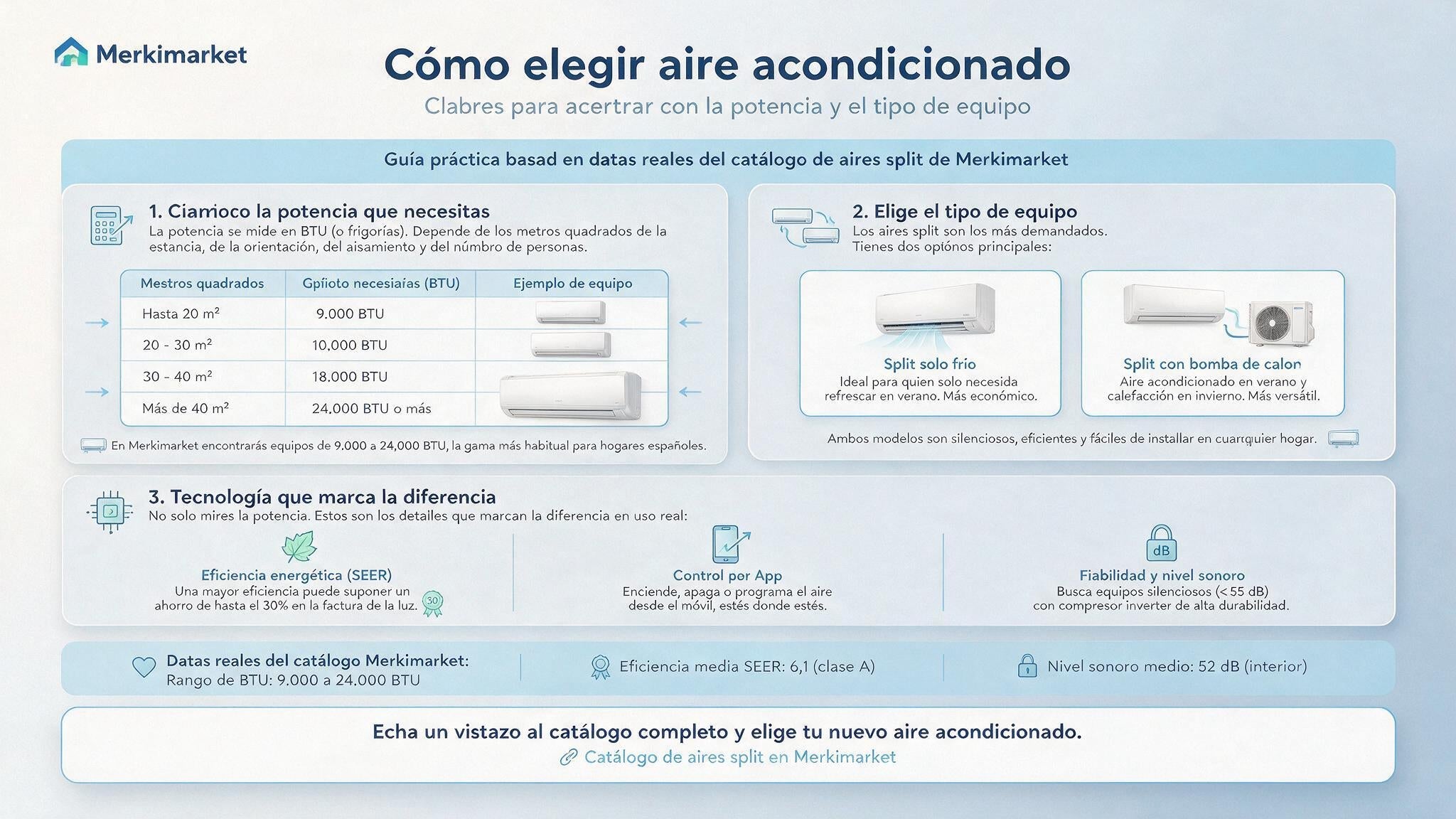
The most commonly used rule of thumb is to calculate around 100 frigorías per square meter in a standard room (2.5m ceiling, correct insulation, and moderate sun). Power should be increased if the room has significant sun exposure, large windows, or high ceilings. This table gives you a quick reference:
| Power (BTU) | Approx. Frigorías | Suggested Surface Area | Typical Use |
|---|---|---|---|
| 9,000 | ~2,250 | Up to 20-22 m² | Bedroom, home office |
| 12,000 | ~3,000 | 20-30 m² | Small living room, large bedroom |
| 18,000 | ~4,500 | 30-45 m² | Large living room, open-plan space |
| 24,000 | ~6,000 | 45-60 m² | Large living-dining room, commercial space |

A piece of advice: do not oversize "just in case." A unit that is too powerful cools in bursts, starts and stops constantly, and consumes more energy; one that is properly adjusted maintains temperature more stably and quietly.
Inverter, heat pump, and WiFi: which technologies matter
Beyond frigorías, three technologies mark the difference between a good unit and a mediocre one:
Inverter. It is practically essential today. Instead of switching the compressor on and off at full power, it regulates its speed to maintain temperature continuously. The result is lower consumption, less noise, and a much more stable temperature. All reference-level split systems today, such as the 12,000 BTU inverter model with WiFi, feature this technology.
Heat pump. It allows the same device to be used for cooling in summer and heating in winter. Since it takes advantage of the heat in the outside air instead of generating it via resistance, it offers very high performance: for every kWh of electricity, it can deliver the equivalent of three or four in heat. If you are looking for a single device for the whole year, this is the logical choice, as with the 24,000 BTU split with heat pump.
Connectivity and comfort. Integrated WiFi allows you to control the unit from your mobile phone and program it so the house is at the desired temperature when you arrive. Added to this are daily conveniences: night or silent mode, timers, washable filters, and automatic modes that adjust power on their own.

Energy efficiency: SEER, SCOP, and the label
The efficiency of an air conditioner is not measured in an instant, but over the entire season. That is why the energy label uses two seasonal indices: SEER assesses efficiency when cooling, and SCOP assesses efficiency when heating with the heat pump. The higher these numbers, the better: an A+++ class unit in cooling consumes significantly less than an A+ unit for the same job, and that difference shows on the bill over a whole summer.
Before focusing only on the purchase price, look at the energy class and estimate usage costs: a slightly more expensive but much more efficient unit usually ends up cheaper after a few years. If you are not sure how to read this data, our guide on what the energy label is and how to interpret it will help you, as it applies to air conditioning just as it does to other appliances.
Installation: what you need and who can do it
Installing a split is not a DIY assembly. Spanish regulations require that refrigerant gas handling be carried out by a certified installer with a fluorinated gas license, so the typical process is as follows:
- Unit location. It is decided where the indoor unit will go (an open wall, with no furniture in front) and the outdoor unit (well-ventilated and accessible for maintenance).
- Distance between units. The route for the copper piping is checked; the greater the distance and elevation, the higher the losses and installation costs.
- Drilling and laying. A wall opening is made for pipes, wiring, and the condensate drain hose.
- Connection and vacuum. The technician connects the lines, vacuums the circuit, and charges or releases the gas according to the unit.
- Start-up and testing. It is verified that it cools and heats correctly, that there are no leaks, and that the drain is working well.
Also, plan where the condensation water will drip and the noise level of the outdoor unit relative to your neighbors: these are the two details that cause the most problems when improvised.
Basic maintenance
A well-cared-for air conditioner lasts longer and consumes less energy. What you can essentially do yourself: clean or wash the indoor unit filters every few weeks during the season of use, keep the outdoor unit clear, and check that the drain is not clogged. Once a year, a more complete check by a professional is recommended, especially if you notice that it is cooling less or making new noises. Just like when choosing other large appliances, small, periodic maintenance avoids expensive repairs.
Frequently asked questions about air conditioning
How many frigorías do I need per square meter?
As a reference, around 100 frigorías per square meter in a normal room. A 25 m² living room would require about 2,500-3,000 frigorías, meaning a unit of about 12,000 BTU. Adjust upward if there is a lot of sun, large windows, or high ceilings.
What is the difference between BTU and frigorías?
They are two ways of measuring the same cooling power. 1 BTU/h is equivalent to about 0.25 frigorías/h, so a 12,000 BTU unit is around 3,000 frigorías. Manufacturers usually indicate BTUs, while in Spain people talk more about frigorías.
Is the heat pump worth it?
Yes, if you want a single unit for the whole year. The heat pump heats in winter with much higher performance than an electric heater, taking advantage of the heat in the outside air, and it barely increases the cost of the device compared to one that only cools.
Can I install the air conditioner myself?
It is neither recommended nor generally legal to handle refrigerant gas without the corresponding license. The split installation must be performed by a technician certified in fluorinated gases, who also guarantees that there are no leaks and that the charge is correct.
Article written by the Merkimarket editorial team. The power outputs, technologies, and models cited are taken from the actual technical specifications in the Merkimarket air conditioning catalog. The frigorías calculations are indicative; for exact sizing, consult with an installer. Availability and prices may vary; check each product sheet for the current information in Spain.





