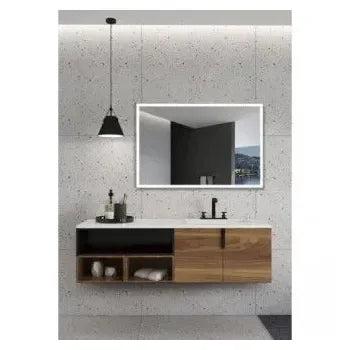
An LED mirror is a bathroom mirror with built-in energy-efficient LED lighting—backlit, front-lit, or perimeter-lit—to provide even illumination for shaving or applying makeup. Current models usually feature sensor activation, an anti-fog system, and multiple color temperatures, and must have a protection rating suitable for the humidity of the bathroom.
Choosing an LED mirror seems straightforward until you stand before the catalog: round or rectangular, cool or warm light, with or without a sensor, backlit or front-lit… and, above all, the question almost no one answers well: what protection rating does an electrical appliance mounted on a damp wall need? This guide breaks down those criteria one by one. All information on models, dimensions, and finishes is taken from the actual product pages of Merkimarket bathroom mirrors.
Key features of an LED mirror
- What it is: a bathroom mirror with built-in LED lighting, not a regular mirror with a separate wall light.
- Types of light: backlit (rear halo), front-lit/Triled (over the reflection), and perimeter or fully illuminated.
- Color temperature: warm (~2700–3000 K), neutral (~4000 K), and cool (~6000–6500 K); neutral is the most accurate for applying makeup.
- Protection: look for at least IP44 in the sink area due to humidity and splashes.
- Common features: touch or motion sensor, anti-fog system, and dimming.
- Shapes and dimensions: round mirrors measuring 60–100 cm in diameter and rectangular/square mirrors measuring 70 to 160 cm wide.
- Warranty: the legal minimum of three years for consumers in Spain, plus the seller's commercial warranty.
Now you have the map; next, we will develop each point so you can choose wisely.
What an LED mirror is (and what it isn't)
An LED mirror has LED strips built into the glass itself or its aluminum frame, powered by a small transformer hidden behind it. It is not the same as hanging a conventional mirror and adding a wall light: here the light is part of the mirror, it is distributed evenly, and it avoids the harsh shadows that distort the face. This integration is precisely what requires looking at two things that would be irrelevant with a normal mirror: the electrical installation and the degree of protection against water.
In the Merkimarket catalog, most of these mirrors are from the LedImex brand, with series named after cities—Oporto, Lisbon, Paris, Switzerland, Greece, Holland, Italy, France, or New York—that differ in shape, type of light, and features. It is the same logic of "series" used by faucet brands: each name is a family with its own character.

IP protection rating: safety comes first
Electrically, the bathroom is one of the most sensitive rooms in the house. The Low Voltage Electrotechnical Regulations (ITC-BT-27) divide the bathroom into volumes based on the distance to the bathtub or shower tray, and require a minimum IP protection rating in each one. The IP code has two digits: the first is protection against solids (dust) and the second against water.
| Volume | Location | Minimum required IP |
|---|---|---|
| Volume 1 | Above the bathtub or shower, up to 2.25 m | IPX4 (IPX5 if there are jets) |
| Volume 2 | 60 cm around volume 1 | IPX4 (IPX5 if there are jets) |
| Volume 3 | Rest of the bathroom, including the sink area | No specific requirement, but IP protection is recommended |
In practice, although the sink mirror usually falls outside the most demanding volumes, the sensible advice is not to go below IP44: it protects against splashes and the continuous steam of a bathroom with little ventilation. And one rule that allows no exceptions: any electrical connection for the mirror must be connected to an installation with a ground connection and residual current device, and ideally, it should be carried out by an installer if there is no planned light point.
Lumens and color temperature: the key to seeing yourself well
A beautiful mirror is useless if the light leaves your face dull or with an unnatural tone. Two variables rule here. The color temperature, measured in kelvin (K), determines whether the light is warm, neutral, or cool: warm (2700–3000 K) is welcoming but yellow; cool (6000–6500 K) is very bright but tends toward a hospital tone; and neutral (around 4000 K) is the one that most closely resembles daylight and is the most recommended for shaving or applying makeup with accuracy. That is why many models offer cool light as standard and the most complete ones allow you to change the tone.
The other variable is the amount of light, in lumens. The mirror provides what is called task lighting, which shines directly on the face, and it is advisable that it complements good general ceiling lighting rather than replacing it. A useful tip when comparing: also look at the color rendering index (CRI); the higher it is, the more faithful skin colors will look.

Backlit, front-lit, or perimeter: types of lighting
Not all LED mirrors illuminate the same way, and the difference is very noticeable in the result:
- Backlit. The light comes out from behind the glass and creates a soft halo against the wall. It is the most decorative and the one that looks best turned on as ambient light; models like the Oporto or the Switzerland follow this idea.
- Front light (Triled type). The lighting falls on your reflection from the mirror itself, from the front. It is the most effective option for applying makeup or shaving because it does not leave shadows; this is the case of series like Paris or Malta.
- Perimeter or fully illuminated. The light runs along the entire contour or surface, as in the Belgium with a sand finish, and provides the greatest sense of spaciousness.
If your bathroom is small and you want it to look bigger, a backlit or perimeter mirror helps; if what you want is to see yourself perfectly up close, prioritize front lighting.
Useful features: touch sensor, anti-fog, and dimming
Beyond the light, these features make the difference in everyday life:
- Activation sensor. It can be touch (you touch an area of the glass) or motion (it turns on when you approach, without touching anything). Several LedImex models, such as the Lisbon or the London, feature a dual sensor.
- Anti-fog system (defogged). A heater behind the glass prevents it from fogging up with steam from the shower. Series like Tokyo, Holland, or New York incorporate it, and it is almost essential in bathrooms without windows.
- Intensity dimming and tone changing. It allows you to go from a soft ambient light to maximum power for grooming.

Dimensions and how high to place the mirror
Placement is as important as the model. This is how not to make a mistake:
- Measure your sink. As a rule, the mirror should not be wider than the cabinet or the sink; it looks better equalized or slightly narrower.
- Calculate the height. The center of the mirror usually looks good at eye level; a common reference is to leave the lower edge about 100–110 cm from the floor, adjusting to the height of the person who will use it.
- Leave space above the faucet. Between the top of the faucet and the edge of the mirror, it is advisable to leave a few centimeters so it does not sit flush against it.
- Plan the electrical outlet. Before drilling, locate where the cable enters and make sure the connection is hidden and protected.
In terms of shapes, round ones (60–100 cm in diameter) soften bathrooms with straight lines; rectangular and square ones (from 70 to 160 cm) make better use of double sinks and wide cabinets.
Comparison of LED mirror series at Merkimarket
To give you an overview at a glance, these are some of the most representative series in the catalog and what each one stands out for:
| Series | Shape | Type of light | Stands out for |
|---|---|---|---|
| Oporto | Round | Backlit | The entry-level option, in cool or warm light |
| Switzerland | Square | Backlit | Matte black frame and dual sensor |
| Paris | Round | Front Triled | Direct light ideal for grooming |
| Holland | Rectangular | Front | Motion sensor and anti-fog |
| Tokyo | Elliptical | Perimeter | Anti-fog and aluminum frame |
| Belgium | Round | Fully illuminated | Sand finish and maximum spaciousness |
How to choose your LED mirror in 4 steps
- Decide on the shape according to your sink. Round to soften, rectangular or square to make use of wide and double sinks.
- Choose the type of light by its use. Front if you apply makeup or shave daily; backlit or perimeter if you prioritize the decorative effect.
- Check protection and features. At least IP44, and add anti-fog if the bathroom does not ventilate well and a sensor if you value convenience.
- Confirm the electrical installation. Planned light point, ground connection and, if there is none, budget for the intervention of an installer.
Ready to see it as a product? Explore the entire collection of bathroom mirrors with LED light or enter two reference models: the Oporto backlit round mirror, one of the most affordable, and the Switzerland square mirror with dual sensor. And if you are completely renovating the bathroom, our guides on modern bathroom lighting ideas, modern bathrooms, and bathroom furniture will come in handy.
Frequently asked questions about LED mirrors
What IP protection rating does an LED mirror in the bathroom need?
At least IP44 in the sink area, due to splashes and steam. In the areas closest to the shower or bathtub (volumes 1 and 2 of the REBT), IPX4 is required as a minimum, and the connection must always have a ground connection and residual current device.
What light is better, cool or warm, for applying makeup?
The most accurate is neutral light, around 4000 K, because it resembles daylight and does not alter skin tones. Cool light illuminates a lot but can be harsh, and warm is more decorative. Many models allow you to change the tone.
Is the anti-fog system worth it?
Yes, especially in bathrooms without windows or with little ventilation: a heater behind the glass prevents it from fogging up after the shower. It is one of the features that is most appreciated in daily use.
At what height is the bathroom mirror placed?
As a reference, the center at eye level and the lower edge about 100–110 cm from the floor, leaving a few centimeters of space above the faucet. It is advisable to adjust it to the height of those who will use it.
Article written by the Merkimarket editorial team. Model data, shapes, finishes, and features taken from the product pages of the Merkimarket bathroom mirror catalog. The indications on volumes and IP follow the Low Voltage Electrotechnical Regulations (ITC-BT-27); in case of any installation doubt, consult an authorized installer.