

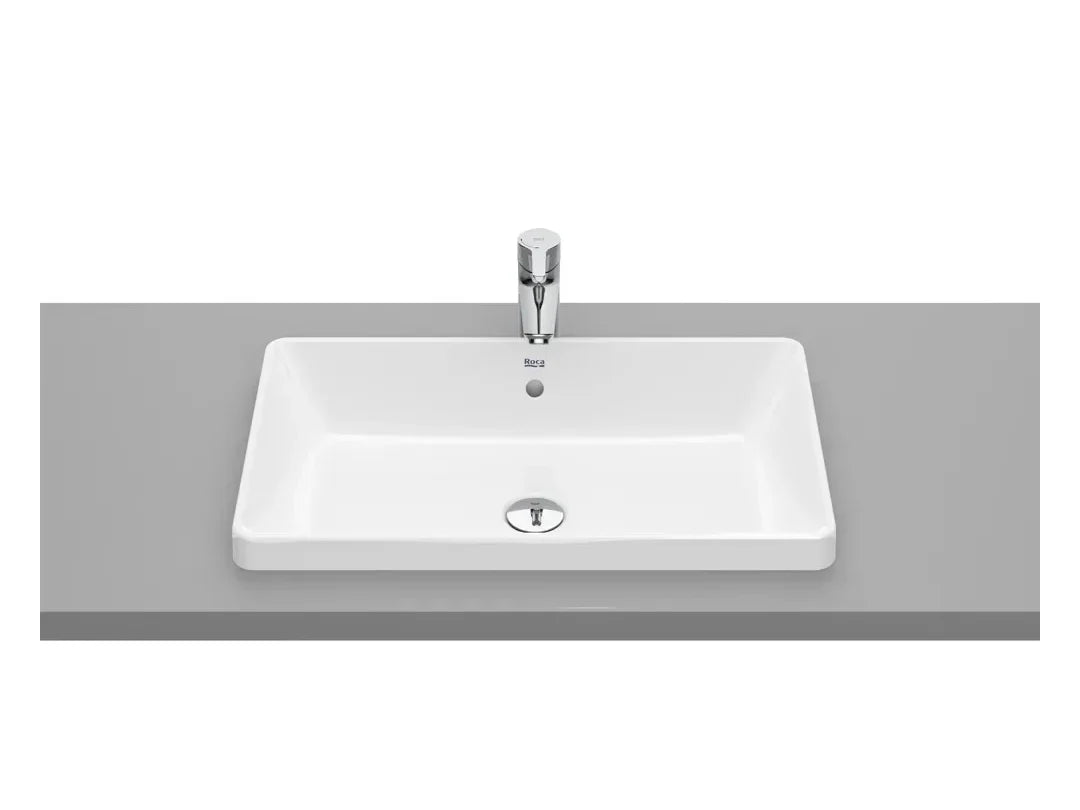
A countertop washbasin is a piece that rests on the top of a bathroom cabinet or countertop, without being recessed, leaving the bowl visible. The assembly is installed with the countertop at a height between 80 and 95 cm and accepts round, oval, or rectangular shapes, almost always in porcelain.
The countertop washbasin has become the protagonist of many modern bathrooms because it combines an obvious decorative flair with relatively simple installation. But choosing it well is not just a matter of aesthetics. The final height, the dimensions of the bowl, the type of faucet, and the drain determine whether it will be comfortable to use every day. In this guide, we gather what you need to know to get it right, with data taken from real spec sheets in the Merkimarket washbasin catalog.
Key facts about the countertop washbasin
- What it is: A bowl that sits on top of the cabinet or countertop, without being recessed, with the outer wall exposed.
- Recommended usage height: The top edge of the bowl is usually comfortable between 85 and 95 cm from the floor.
- Cabinet/countertop height: It is lowered compared to a traditional washbasin to compensate for the height of the bowl; approximately 80-85 cm for the countertop.
- Common materials: Glazed porcelain and technical ceramics like FineCeramic, which are more resistant and have thinner walls.
- Shapes: Round, oval, square, or rectangular; frequent diameters and widths from 37 to 60 cm.
- Faucet: Requires a high-spout washbasin faucet or a wall-mounted faucet, because the water falls from higher up.
- Drain: Usually a click-clack valve without an overflow, with an exposed or bottle siphon hidden in the cabinet.
With this general overview, you can now get your bearings; from here on, we develop each decision so that no detail fails you.
What a countertop washbasin is and how it differs
A countertop washbasin is, literally, a bowl that sits on the surface of the cabinet instead of being recessed into it. The difference from other solutions is easy to see: the wall-mounted or suspended washbasin attaches to the wall and does not need a cabinet underneath; the recessed or semi-recessed washbasin is fully or partially embedded in the countertop, leaving the edge flush; and the countertop washbasin remains completely above, like a resting bowl, showing its entire silhouette.
That visible silhouette is its great aesthetic asset and also its main technical constraint. By raising the point where water falls and is collected, it requires rethinking the height of the cabinet and the faucet. In exchange, it offers a huge variety of shapes and facilitates future changes: replacing the bowl is easier than chipping into a countertop to free a recessed washbasin.

At what height is a countertop washbasin installed
This is the question that trips up first-time buyers the most. In a traditional washbasin, the countertop is placed at about 85-90 cm from the floor and the functional edge is right there. With a countertop washbasin, you must add the height of the bowl, which is usually around 10-15 cm. If you do not compensate for this, you end up with the edge at more than a meter high and an uncomfortable posture for washing your face.
The rule of thumb is simple: decide first at what height you want the top edge of the bowl—a comfortable reference for most adults is between 85 and 95 cm—and subtract the height of the bowl to know at what height the countertop or cabinet should be. That is why cabinets designed for countertop washbasins are slightly lower, around 80-85 cm, than those designed for recessed washbasins.
Measurements and space: how to size the assembly
Before you fall in love with a shape, measure. The washbasin must have clearance in front and on the sides to be comfortable and easy to clean. As a guide, it is advisable to leave about 15-20 cm of free countertop behind the bowl (for the faucet if it is deck-mounted) and a few centimeters on each side to rest things and wipe down. A bowl with a 40 cm diameter requires a cabinet significantly wider than that diameter.
Also look at the depth of the cabinet: many rectangular bowls 55-60 cm wide fit without problems in standard cabinets, but very deep bowls can invade the space for the faucet if it is deck-mounted. And do not forget the interior space of the cabinet: the siphon of a countertop washbasin goes down through the center and can collide with drawers; cabinets prepared for this solution usually have a cut-out drawer or a pass-through space.
Materials and shapes: porcelain, FineCeramic, and designs
The vast majority of countertop washbasins are made of glazed porcelain, a hard, hygienic, and easy-to-clean material that holds up well to daily use. Some ranges use technical ceramics like FineCeramic, which allow for thinner walls and more stylized silhouettes while maintaining strength. Regardless, the glaze is what prevents water and limescale marks, so the quality of the glazing matters as much as the shape.
Regarding design, there is something for every taste. This is a sample of real models from the catalog so you can see the range of shapes and sizes:
| Model | Shape | Approximate size | Material |
|---|---|---|---|
| Roca Round | Round | 40 cm diameter | Porcelain |
| Roca Ona | Circular, deep bowl | Compact (around 37 cm) | Porcelain |
| Roca Square | Square | 42 cm | Porcelain |
| Roca Diverta | Rectangular | 50-55 cm wide | Porcelain |
| Roca Ohtake | Oval, thin walls | Medium format | FineCeramic |

Faucets for countertop washbasins
The faucet is where most people go wrong. Because the bowl is elevated, a standard washbasin faucet is too low: the spout barely pokes out over the edge and splashes or does not reach the center well. The solution is a high-spout faucet specifically for countertop washbasins, or a wall-mounted faucet that drips down over the bowl.
If you opt for a high-spout deck-mounted faucet, check two things: that the height of the water outlet clears the edge of the bowl with plenty of room, and that the spout reach lets the stream fall close to the center of the drain, not against the wall of the bowl. If you decide on a wall-mounted faucet, it must be planned during the construction phase because it requires bringing the water supply to the wall at the appropriate height. You can see options in the washbasin faucets section and choose the finish that matches the rest of the bathroom.
How to install a countertop washbasin step by step
Installation is within reach of a handy DIYer, although it is best to proceed in order. Broadly speaking, the process is as follows:
- Check heights and drain. Confirm that the cabinet leaves the edge of the bowl at a comfortable height and that the wall drain outlet aligns with the siphon path.
- Mark and drill for the drain. Position the bowl, mark the center of the drain on the countertop, and drill the hole with the appropriate bit for the cabinet material.
- Assemble the valve. Place the valve (usually click-clack, without overflow) sealing the joint between the bowl and valve well to prevent leaks.
- Seal and set the bowl. Apply a bead of neutral silicone to the base and set the washbasin, cleaning up the excess before it cures.
- Connect the siphon. Join the valve with the siphon (exposed or bottle) and connect it to the wall outlet, checking that all joints are tightened.
- Install the faucet and test. Mount the high-spout or wall-mounted faucet, turn on the water, and check for a few minutes that there are no leaks in the valve, siphon, or supply hoses.

Common errors in choosing and installing
The most common stumbles are almost always the same, and all can be avoided by planning. The first is ignoring height: mounting the bowl on a standard cabinet and discovering the edge is uncomfortably high. The second is using a normal washbasin faucet instead of a high-spout one, resulting in splashing. The third is choosing a bowl that is too large for the cabinet, leaving the countertop without usable space on the sides.
There are two others that prove costly: not anticipating the siphon colliding with the cabinet drawers, and neglecting the sealing of the base and valve, the source of leaks that end up damaging the cabinet from the inside. Dedicating ten minutes to measuring and checking joints saves many headaches. If you are redoing the entire set, it will be useful to review the types of washbasins and, for the rest of the faucets, our guide on bathroom faucets.
Frequently Asked Questions
At what height is a countertop washbasin placed?
It is comfortable to have the top edge of the bowl between 85 and 95 cm from the floor. Since the bowl adds about 10-15 cm, the cabinet or countertop should be lower than with a traditional washbasin, around 80-85 cm.
What faucet does a countertop washbasin need?
A high-spout faucet designed for elevated bowls or a wall-mounted faucet. A standard washbasin faucet is too low and causes splashes.
Does it need an overflow?
Most countertop washbasins do not have an overflow, so they are installed with a click-clack valve without overflow. It is advisable to check the spec sheet before buying the valve.
Is it difficult to install?
Not especially. It requires drilling for the drain, sealing the base and valve well, and mounting the appropriate faucet. With organization and good sealing, it is an achievable installation in a renovation.
Ready to choose yours? Explore all models in the Merkimarket washbasin collection or go directly to two popular references to get an idea: the Roca Ona circular washbasin and the Roca Diverta rectangular washbasin.
Article written by the Merkimarket editorial team. Technical data (shapes, measurements, and materials) taken from the Merkimarket washbasin catalog spec sheets. The measurements are indicative and availability may vary; check each spec sheet for the current information in Spain.





