

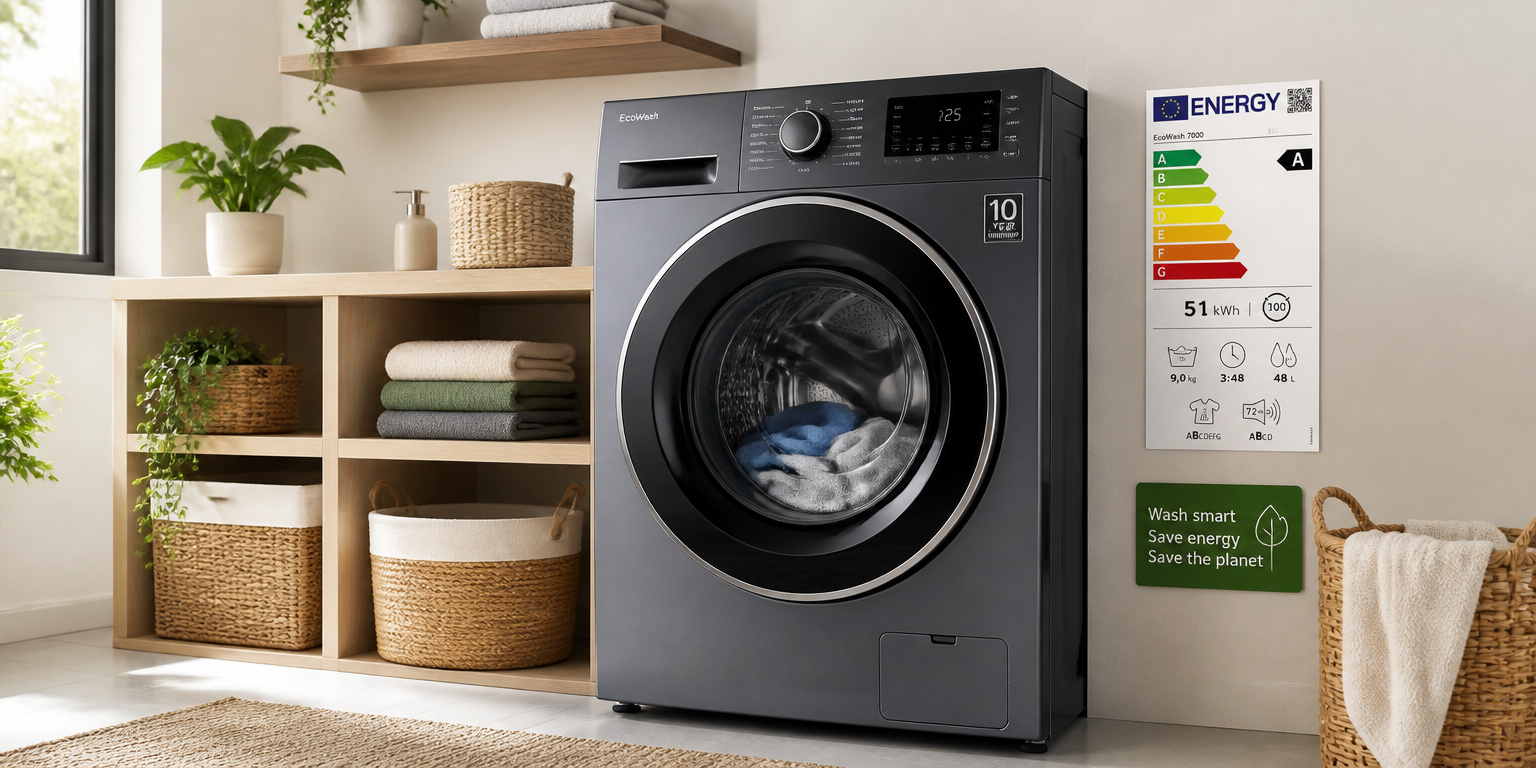
Choosing a washing machine is about adjusting five variables to your home: capacity in kilos based on the number of people, the type of loading (front or top), spin speed, the programs that are actually useful, and the energy efficiency class, which determines water and electricity consumption throughout its entire useful life.
Buying a washing machine seems simple until you find yourself in front of dozens of models with recurring figures: 8 kg, 1400 rpm, class A, inverter motor, 16 programs. This guide organizes these variables by order of importance so that you can choose based on criteria and not just the flashiest label. The technical data and examples are taken from real product sheets in the Merkimarket washing machine catalog.
Key data before buying
- Capacity: measured in kilos of dry laundry; standard models range from 6 to 12 kg.
- Loading type: front (the most widespread, allows for a countertop and furniture above) or top (narrower, comfortable without bending over).
- Spin speed: between 1000 and 1400 rpm; at higher speeds, laundry comes out drier and the dryer works less.
- Motor: inverter motors are quieter, more durable, and more efficient than traditional brush motors.
- Programs: what matters isn't how many there are (usually 11 to 16), but having fast, eco, delicate, and, if possible, steam settings.
- Efficiency: the European energy label (from A to G) marks actual electricity and water consumption.
- Warranty: statutory minimum of three years for consumers in Spain, plus the seller's commercial warranty.
With this summary, you can now rule out models; below, we develop each point to refine your decision.
Capacity: how many kilos you really need
Capacity is the first decision and the one most people get wrong, almost always by going overboard. It is measured in kilos of dry laundry that fit in a wash, and the rule of thumb is simple: calculate about 2 kg per person for daily use and add a margin for bedding and towels. A washing machine that is too large for a small home is used half-empty, spends the same amount per cycle, and takes up extra space; one that is too small forces you to wash more often.
| Household | Recommended capacity | Usage example |
|---|---|---|
| 1-2 people | 6-7 kg | Frequent loads and flats with little space |
| 2-3 people | 8 kg | The best-selling and most versatile size |
| 3-4 people | 9-10 kg | Families with regular bedding and sports laundry |
| 5 or more people | 10-12 kg | Large families or washing duvets |
This range is clearly visible in the catalog: from the compact 6 kg Bolero DressCode 620 for single-occupancy apartments, to the 8 kg Inverter A washing machine with SteamMax —the best-selling size—, to the 10 kg Inverter A washing machine for households of 3-4 people, or the 12 kg Bolero 12980 designed for large families.
Front loading or top loading
The vast majority of washing machines sold in Spain are front-loading: they load through a door with a window, allow for furniture or a countertop above, and usually offer more capacity and better spin speeds. Their only drawback is that you have to bend down to load them. Top-loading machines are narrower (about 40-45 cm wide), don't require you to bend down, and fit well in kitchens or utility rooms with very limited space, in exchange for not being able to place anything on top. If space is not a serious problem, front-loading is the most versatile option for most homes.

Spin speed: what changes between 1000 and 1400 rpm
Revolutions per minute (rpm) indicate the speed at which the drum rotates during the spin cycle, i.e., how much water it extracts from the clothes before taking them out. At higher rpm, clothes come out drier and will need less hanging time or less time in the dryer. Most of the market moves between 1000 and 1400 rpm: 1000-1200 rpm is more than enough for day-to-day use, while 1400 rpm pays off if you use a dryer frequently or live in a humid area. Be careful: a very high spin speed is more aggressive with delicate garments, for which it is advisable to lower the revolutions using the appropriate program.
Inverter motor and noise: what you don't see on the label
The type of motor makes a difference in the long term. Inverter motors (like the Inverter Plus found in many Bolero models) eliminate the brushes that wear out in traditional motors: this makes them quieter, more durable, and more efficient, especially during the spin cycle. If the washing machine will be in a kitchen open to the living room or near bedrooms, the noise level—which the product sheet usually expresses in decibels—is as important as the programs. A good inverter motor with good insulation is what allows you to run a load at night without disturbing anyone.
Programs and functions you will actually use
It is easy to be dazzled by a panel with 16 programs, but in practice, you only use four or five. These are the ones you should make sure to have:
- Fast / express: washes a light load in 15-30 minutes, ideal for everyday use.
- Eco: extends the cycle but lowers water and electricity consumption; it is the reference program for the energy label.
- Delicate / wool: gentle spin for sensitive garments.
- Steam: reduces wrinkles and helps eliminate allergens; many models call this SteamMax.
- Auto-dose: the washing machine doses the detergent for you in each load, avoiding excess.
A balanced example of this philosophy is the 9 kg Inverter Plus washing machine with steam and 16 programs, which combines class A, inverter motor, and steam function in a size suitable for most families.
Consumption and energy label: how much you really save
The efficiency class (from A, the best, to G) is what carries the most weight in spending over the years. The current European energy label does not just indicate the letter: it also details energy consumption per 100 cycles, water consumption per wash, capacity, and spin class. A class A washing machine versus a class D can mean a notable difference in your bill if you do several loads per week. If you want to understand every icon on that sticker, we explain it in detail in what the energy label is and how to interpret it. And to squeeze out savings in the rest of the house, you have practical ideas in small appliances that save time and energy.

Washing machine alone or washer-dryer?
If you don't have room for two appliances, a washer-dryer combines both functions in a single body, such as the 10 kg Bolero Wash&Dry 10680. It is the perfect solution for small flats, with the caveat that the drying capacity is usually less than the washing capacity and the full cycle consumes more. If you have space, the alternative is an independent washing machine and dryer, which you can stack with a stacking kit to gain height without taking up more floor space.
How to choose your washing machine in 5 steps
- Set the capacity. Count the members of the household (2 kg per person) and decide between 6-7, 8, 9-10, or 12 kg.
- Measure the space. Width, depth, and height available, and check if you need a top-loader due to narrowness or if you can place furniture on top.
- Choose the motor type. Prioritize inverter for durability and noise, especially if the washing machine is near living areas.
- Check the energy class and key programs. Look for class A and make sure to have fast, eco, delicate, and, if possible, steam.
- Decide on a washing machine alone or washer-dryer. Based on space and whether you need to dry in the same appliance.
Ready to compare models using these criteria? Explore the complete catalog of Merkimarket washing machines, with shipping throughout Spain.
Frequently asked questions about washing machines
How many kilos of washing machine capacity do I need?
As a reference, calculate about 2 kg of capacity per person for daily use. A household of one or two people gets by with 6-7 kg, most families do well with 8 kg, and households with four or more members will appreciate 9-12 kg for washing bedding and duvets.
Is front-loading or top-loading better?
Front-loading is the most versatile: greater capacity, better spin speeds, and it allows for furniture on top. Top-loading is narrower and avoids bending down, so it fits in kitchens or utility rooms with little space where you are not going to place anything on the washing machine.
What does class A mean on a washing machine?
Class A is the best letter on the European energy label and indicates the lowest energy and water consumption per cycle. Compared to lower classes, it translates into noticeable savings on your bill if you do several loads per week.
Is a washer-dryer worth it?
Yes, when space is at a premium: it combines washing and drying in a single appliance, ideal for small flats. If you have the space, two independent units offer more drying capacity and more efficient cycles, and they can be stacked with a stacking kit.
Article written by Antonio Garcia for Merkimarket. The data on capacities, revolutions, and functions come from real product sheets in the Merkimarket washing machine catalog. Availability and prices may vary; check each sheet for the current information in Spain.





