

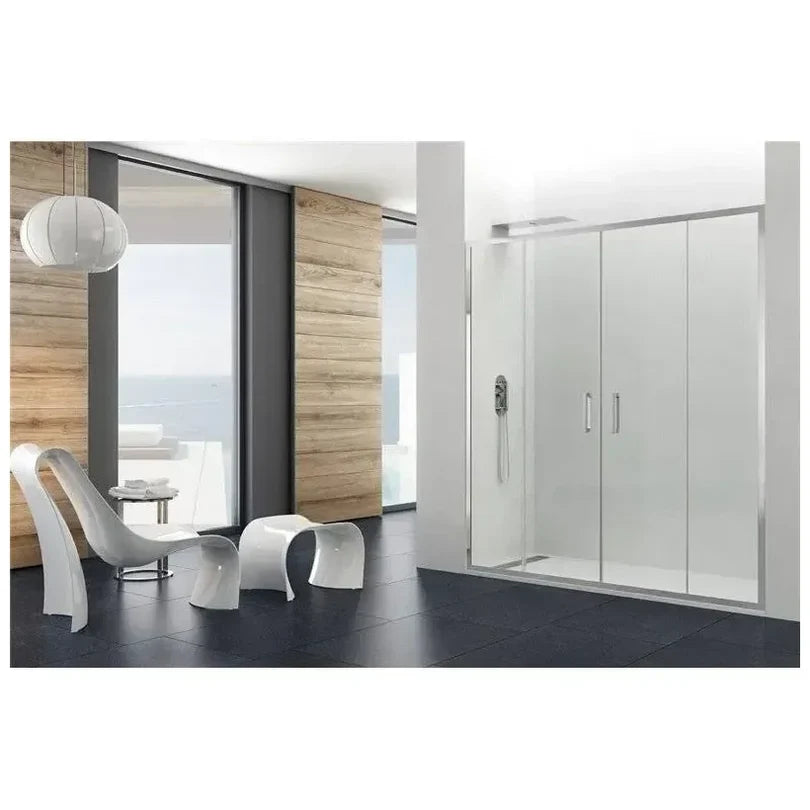
A sliding, folding, or fixed shower screen is the tempered glass enclosure that isolates the shower tray; the sliding door opens laterally without encroaching on the bathroom, the folding (hinged) door swings inwards or outwards, and the fixed one is a walk-in panel without a door, ideal depending on the available space.
Choosing a shower screen isn't about aesthetics; it's about centimeters. The same bathroom can accommodate one solution or another depending on the size of the opening, which way the door opens, and how much clearance space you have left. In this guide, we compare the three main opening systems—sliding, folding (hinged), and fixed—with their real measurements, advantages, and drawbacks, so you can get it right the first time. All models cited are taken from actual product sheets in the Merkimarket shower screen catalog.
Key facts before you choose
- Sliding: opens by sliding horizontally. Does not encroach on the bathroom. Ideal when there is little clearance space in front of the shower.
- Folding or hinged: the panel rotates on a hinge. Requires swing clearance, but provides a wide, clear opening.
- Fixed (walk-in): glass panel without a door. Maximum sense of spaciousness and easy cleaning; requires a well-sized shower tray.
- Common glass: 6 mm tempered safety glass in standard ranges and 8 mm in higher-end models.
- Anti-limescale treatment: finishes like EnduroShield repel limescale and dirt, greatly reducing cleaning.
- Customized: most GME models are adjustable or made to measure, with reversible panels to set the opening to the left or right.
- Warranty: a legal minimum of three years for consumers in Spain, plus the seller's commercial warranty.
With this, you have the map; now we will develop each system so you know which one fits your bathroom.
The three types of screens at a glance
Before going into detail, this table summarizes how they differ and for which bathroom each opening system performs best:
| Type | How it opens | Space required | Ideal bathroom |
|---|---|---|---|
| Sliding | Sliding horizontally on a track | None outwards | Narrow bathrooms or those with furniture/toilet in front |
| Folding / hinged | The panel rotates on a hinge (hinged) or folds (folding) | The panel's swing radius when opening | Small showers where the folding hinged door avoids collisions |
| Fixed (walk-in) | Does not open: free access from the side | A large tray to contain the water | Medium or large bathrooms with minimalist aesthetics |
Sliding screens: when they are the best option
The sliding screen is the most practical solution when space is tight. By opening via sliding, it never encroaches on the bathroom: it doesn't matter if you have the toilet, sink, or furniture right in front of the shower, because the panel never opens outwards. That is why it is the queen of narrow bathrooms and renovations where every centimeter counts.
Within the sliding category, there are several configurations. Frontal screens close an opening between two walls; there are those with one sliding panel and one fixed one, such as the BASIC sliding frontal screen by GME, adjustable from 95 to 200 cm and reversible, or those with two panels for wider openings, such as the PRESTIGE series in 8 mm glass, adjustable between 136 and 192 cm. When the shower is in a corner, the corner version—with bypass-type sliding panels—closes both sides at once. The trade-off: the bottom tracks accumulate limescale and should be cleaned often.

Folding or hinged screens: wide opening in little depth
Hinged screens have a panel that rotates on a hinge, and folding ones add a folding action to the panel itself so it takes up even less space when opened. Their great advantage is accessibility: when fully opened, they leave a clear space, comfortable for entering and exiting, and ideal if there are elderly people or those with reduced mobility in the home.
The point to monitor is the swing radius: the panel needs a free arc to open without hitting the toilet or sink. That is why many hinged screens, like the GME OPEN with a fixed front, allow opening both inwards and outwards, and the folding versions reduce this swing to a minimum. They are perfect for square or small shower trays where a sliding one would have little useful travel. They combine a fixed panel with the movable door, so you gain stability without sacrificing a generous opening.

Fixed or walk-in screens: the design option
The fixed screen, also called a walk-in panel, is simply a piece of glass without a door: you enter and exit through the open side. It provides the greatest sense of spaciousness, is the easiest to clean—no tracks or hinges where limescale can accumulate—and fits best in bathrooms with a contemporary aesthetic. A good example is the minimalist screen with fixed panel by GME, in 8 mm glass with anti-limescale treatment and 195 cm high.
Its only requirement is the tray: since there is no door to contain the water, you need a large, well-leveled tray with the shower oriented inwards so it doesn't splash the rest of the bathroom. If space is tight, a short fixed panel might fall short regarding splashes; in medium or large bathrooms, however, it is the most elegant option.
Glass, aluminum, and anti-limescale: what to look for
Beyond the type of opening, the quality of a screen is determined by three details. The glass must always be tempered safety glass: 6 mm covers most cases and 8 mm provides more solidity and visual substance, common in higher ranges. The aluminum profile supports the whole unit; bright silver finishes are the most versatile, although black and brushed nickel are gaining ground in designer bathrooms. And the anti-limescale treatment—of the EnduroShield type—creates a layer that repels water and limescale: it doesn't eliminate the need for cleaning, but it reduces it drastically and keeps the glass transparent for years. One final practical note: always check that the model is reversible so you can decide during installation whether the opening is on the left or right.
How to measure your shower before buying (step-by-step)
- Measure the opening at three heights. Take the width at floor level, at mid-height, and at the top. Walls are rarely perfectly plumb; always use the smallest measurement as a reference.
- Locate the tray. Note the width and depth of the shower tray: the screen is mounted on its edge, not on the bathroom floor.
- Check the clearance space. Look at what is in front of the shower. If there is a toilet or furniture less than 60 cm away, discard a hinged door that opens outwards and go for a sliding or folding one.
- Decide on the opening side. Choose where you want to enter and confirm that the model is reversible to mount it on the left or right.
- Choose the type based on the result. Opening between walls and little depth, sliding; small shower in a corner, folding or hinged; large tray and desire for design, fixed walk-in.
With these measurements in hand, go to the Merkimarket screen catalog and filter by the type that suits you. And if you are still defining the rest of the shower, our guides on types and measurements of shower screens and on how to choose a shower tray, which is the base upon which the entire screen rests, will be useful.
Frequently asked questions about shower screens
Which screen takes up the least space, sliding or folding?
The sliding one takes up no space outwards because it opens by sliding, so it is the best when there is something right in front of the shower. The folding one needs a small swing to open the panel, but it reduces it by folding, and it is very practical for small or square trays.
Is 6 mm or 8 mm glass better?
6 mm tempered glass is safe and sufficient for standard domestic use. 8 mm provides more rigidity, a better sense of quality, and is usually reserved for higher-end models or large panels.
Is the anti-limescale treatment worth it?
Yes. A treatment like EnduroShield makes water slide off and prevents limescale from embedding, so the glass remains transparent with much less cleaning. It is one of the improvements most appreciated in daily life.
Can I put a fixed screen in a small bathroom?
You can, but with care: having no door, the fixed screen needs a large, well-oriented tray so water doesn't splash out. In very tight bathrooms, a sliding or folding screen, which completely closes the shower enclosure, usually performs better.
And if the renovation includes changing the faucets, our guide on shower columns will be useful for choosing between single-lever, thermostatic, or hydromassage.
Article written by the Merkimarket editorial team. Technical data (measurements, glass, finishes, and opening systems) taken from the actual sheets in the Merkimarket catalog. Measurements and availability may vary; consult each sheet for the information currently in force in Spain.





