A kitchen sink is the piece where food is washed and prepared, and it is chosen above all for its material: stainless steel is light, hygienic, and economical; resin or granite provide color and impact resistance; and ceramic offers a very robust, classic finish. From there, you decide on the basin configuration, dimensions, and type of installation.
Choosing a sink seems simple until you find yourself in front of the catalog: one or two basins, with or without a drainboard, over-mount or under-mount, and three families of materials that behave very differently in day-to-day life. In this guide, we explain what sets stainless steel, resin and granite, and ceramic apart, and how to balance that decision with the space in your cabinet so you don't make a mistake. The examples and dimensions are taken from the real kitchen sink catalog at Merkimarket.
Key facts before you buy
- Three main materials: stainless steel, resin/granite (quartz compounds like Quarzex), and ceramic or porcelain.
- Configurations: single basin, double basin, or basin with integrated drainboard.
- Installation: over-mount (the most common), under-mount (clean lines), and flush-mount.
- Reference dimensions: standard widths of 45, 60, 80, 84, 86, and 90 cm; always check the interior width of your under-sink cabinet.
- Stainless steel: typically uses gauges and anti-fingerprint finishes; it is the lightest and easiest option to install.
- Resin/Quarzex: available in various colors (white, gray, black, cream) and highly resistant to impact and heat.
- Warranty: statutory minimum of three years for consumers in Spain, plus the seller's commercial warranty.
With this, you have the map; now let's go material by material.
The three materials at a glance
Before going into detail, this table summarizes what stands out in each family and what to watch out for. None is "the best" in the abstract: it depends on your use, your budget, and the kitchen's aesthetic.
| Material | Strengths | Keep in mind | Positioning |
|---|---|---|---|
| Stainless steel | Lightweight, hygienic, stain-resistant, easy to install | Shows fingerprints and limescale residue; can scratch with use | Entry and mid-range |
| Resin / granite (Quarzex) | Colors, warm feel, very resistant to impact and heat | Heavier; it is advisable to dry it to avoid limescale marks | Mid and high-range |
| Ceramic / porcelain | Classic finish, very hard surface and easy to clean | Heavy and sensitive to direct impacts; fewer models | Mid and high-range |
Stainless steel sinks: the all-rounder
Stainless steel is, by far, the most widespread material, and not by chance. It is hygienic (it doesn't absorb, doesn't stain, and resists food contact well), lightweight, easy to install, and the most affordable of the three. It handles hot water without flinching and, if it ever gets dented or scratched, the wear and tear is hidden much better than on a solid-colored surface.
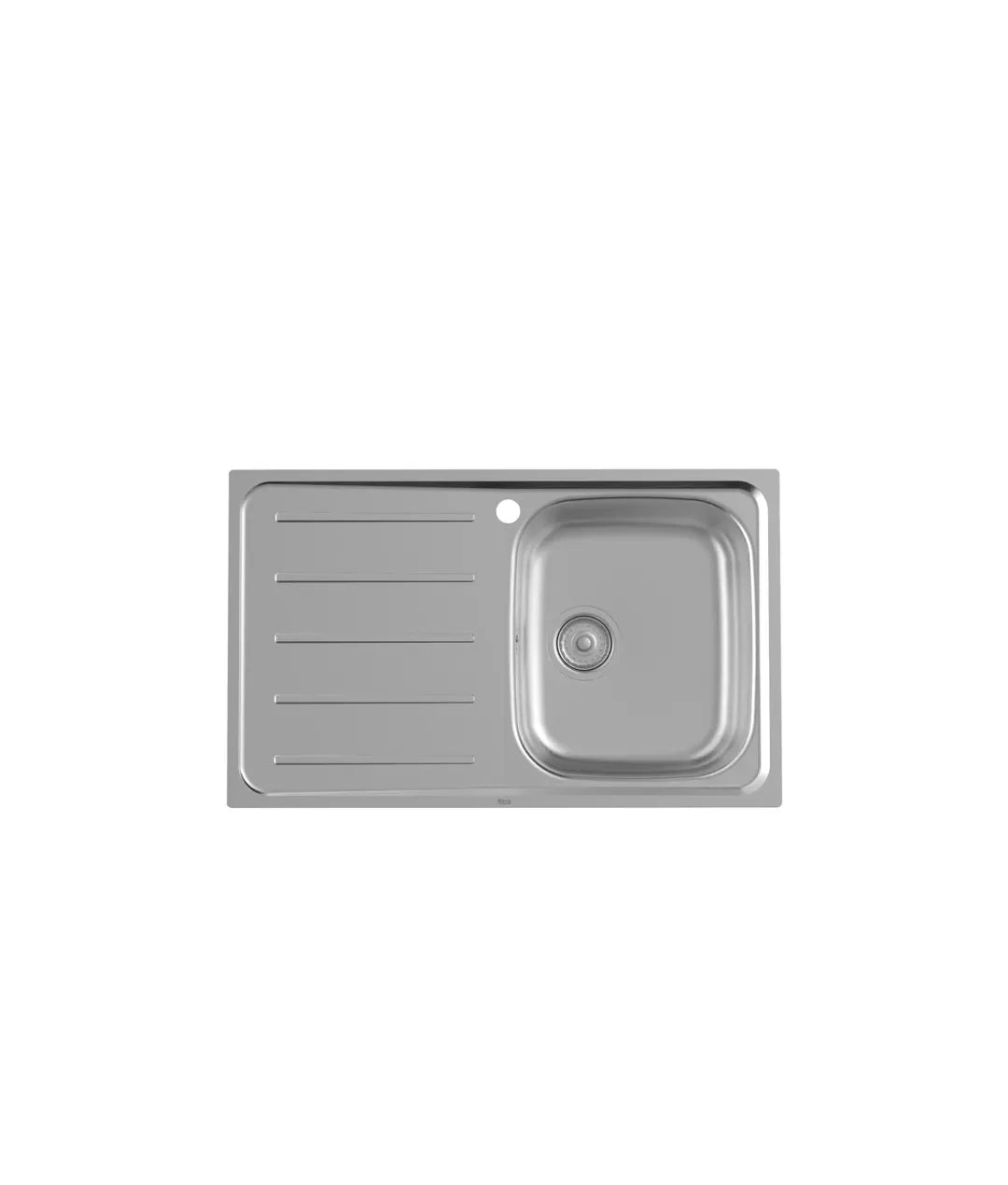
Its two "drawbacks" are well known: it shows fingerprints and limescale residue, especially on high-gloss finishes, and can develop micro-scratches over the years. That is why many current models resort to matte or textured finishes that hide both. In the catalog, you will find everything from compact single-basin formats to 90 cm pieces with a drainboard, such as the 90 cm Victoria stainless steel sink with a drainboard on the left, designed for those who want space for draining without resorting to accessories.

Resin and granite sinks: color and resistance
Under the labels "resin," "granite," or commercial names like Quarzex lie mineral compounds: a mixture of quartz powder (in very high proportions) bound with resin. The result is a dense surface with a warm touch and a matte appearance, which stands out for three reasons: it comes in color (white, cream, gray, black...), it resists impacts very well, and it withstands heat much better than people expect.
In exchange, it is heavier than steel—you have to ensure the cabinet supports it—and, like any solid-colored surface, it benefits from being dried after use to prevent limescale marks in areas with hard water. If you are looking for the sink to be a design element and not just an accessory, this is your family: you can see it in double-basin models like the Oslo resin sink with a choice of color or in Quarzex options like the 86 cm double-basin white Quarzex sink, Oslo model by Roca.

Ceramic sinks: the classic that lasts
Ceramic (or vitrified porcelain) is the traditional material for rustic, farmhouse, or classic-style kitchens, with those recognizable exposed basin fronts. Its enameled surface is very hard, waterproof, and easy to clean, keeping an impeccable white for decades. It is probably the most elegant finish for a traditional-style kitchen.
Its limitations are also clear: it is the heaviest material (requiring a cabinet and installation prepared to support it) and, although the enamel is extremely hard against scratches, a strong, direct impact—like dropping an iron pot—can chip it. Furthermore, the range of models and colors is more limited than in steel or resin. If your kitchen calls for that classic character and you value cleanliness above all else, it pays off; for very intensive and carefree use, steel or resin are more forgiving.
Basins, drainboard, and installation: the other half of the decision
The material is half; the other half is the configuration, and here, the actual space in your kitchen is what dictates the options. Regarding basins: a single large basin is comfortable for pots and pans and provides useful space; the double basin allows you to separate washing and rinsing or to soak while using the other. The integrated drainboard is practical if you don't have free countertop space next to it, but it reduces the basin's width.
Regarding installation, there are three main options. Over-mount installation is the simplest and most common: the sink sits on a cutout. Under-mount installation leaves the countertop exposed and offers a cleaner line (ideal for stone or compact surfaces), but requires countertops that support it. And flush-mount leaves the sink edge level with the countertop. To avoid mistakes, always measure the free interior width of your under-sink cabinet before choosing: a 60 cm cabinet does not accommodate the same sink as an 80 cm one.

How to choose your sink in 6 steps
- Measure the cabinet. Note the free interior width of the under-sink cabinet; it is the limit that dictates everything else.
- Decide on one or two basins. A large basin if you cook with pots and pans; two basins if you organize yourself by separating tasks.
- Drainboard yes or no? If you don't have free countertop next to it, an integrated drainboard will save you; if you do, prioritize a wider basin.
- Choose the material. Steel for intensive use and a tight budget; resin/Quarzex for color and robustness; ceramic for classic aesthetics.
- Define the installation type. Over-mount (easy), under-mount (clean line), or flush-mount, depending on your countertop.
- Finalize faucet, trap, and waste. Check that the faucet fits the number of holes in the sink and that the trap fits inside the cabinet.
Maintenance by material
Care changes little between families, but it should be adapted. For stainless steel, clean with mild soap and dry with a cloth to avoid limescale marks; avoid aggressive metal scouring pads and chlorinated products, which can damage the passive layer. For resin and granite, clean daily with soap and, from time to time, a specific product for mineral compounds; drying the surface helps maintain a uniform color. For ceramic, a damp cloth and non-abrasive products are sufficient; its enamel resists almost everything except heavy impacts. In all three cases, a good trap and a quality waste prevent bad odors and clogs: if you want to delve deeper, it will help to first compare the appropriate kitchen faucet and review the kitchen cabinet dimensions so that everything fits. And if you already have the sink and are just changing the hardware, our guide on how to change the kitchen faucet step-by-step will be useful.
Frequently asked questions about kitchen sinks
Which sink material is best for the kitchen?
There is no single winner. Stainless steel is the most versatile and economical and holds up very well to intensive use; resin or granite provide color and great resistance to impact and heat; and ceramic offers a highly durable classic finish. The best option depends on your budget, your style, and how much it bothers you to dry the surface.
Does a stainless steel sink scratch a lot?
With use, it may develop micro-scratches, but they are hidden better than on a solid-colored surface. Matte or textured finishes and avoiding metal scouring pads significantly reduce the problem.
What is a resin or Quarzex sink?
It is a sink made with a compound of quartz powder bonded with resin. It is very resistant to impact and heat, comes in various colors, and has a matte, warm feel; in exchange, it weighs more than steel.
Is one or two basins better?
A large basin performs better if you cook with pots and pans and you gain useful space. Two basins are convenient for separating washing and rinsing. Decide based on how you cook and, above all, the width of your cabinet.
Ready to choose? Explore the complete catalog of kitchen sinks from Merkimarket, with stainless steel, resin, and different basin configurations, with shipping throughout Spain.
Article written by the Merkimarket editorial team. Material data, dimensions, and configurations are taken from the Merkimarket sink catalog sheets. Availability and prices may vary; check each sheet for current information in Spain.