

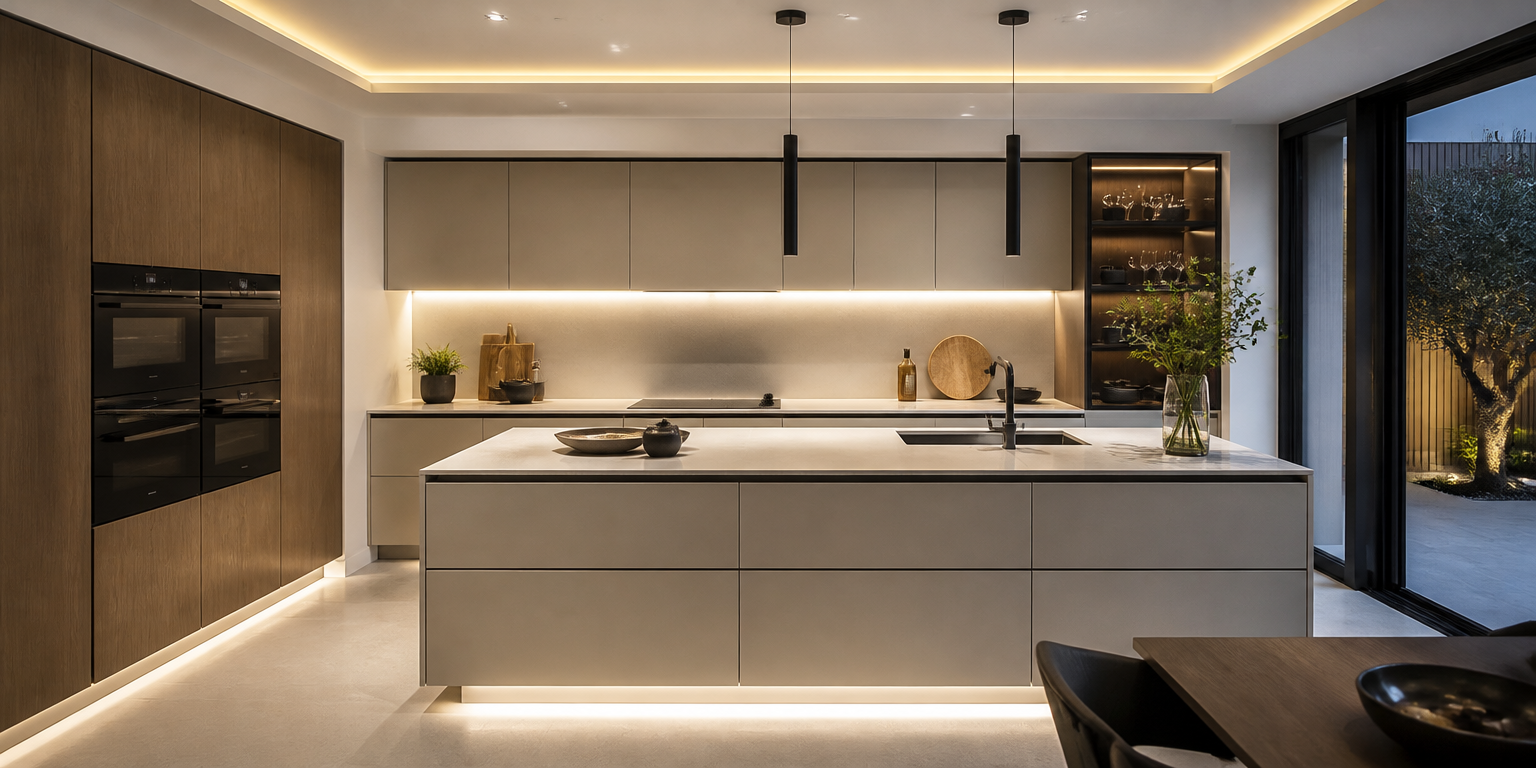
A modern kitchen is one that combines clean lines, durable materials, and a layout designed for daily use, prioritizing functionality and storage without sacrificing design. It is characterized by smooth, handleless fronts, integrated appliances, technical material countertops, and layered lighting that organizes the space.
Designing or renovating a modern kitchen is not about choosing a trendy color, but about making sound decisions on three fronts that always go together: style, layout, and materials. In this guide, we explain how these pieces fit together and which equipment—faucets, sink, cooktop, or hood—completes the set, with real examples from the Merkimarket kitchen catalog so you can move from the idea to the shopping list.
Key facts about a modern kitchen
- Main styles: minimalist, Nordic, industrial, and contemporary, with smooth fronts as a common denominator.
- Common layouts: linear, parallel (double-front), L-shaped, U-shaped, and with an island or peninsula.
- The golden rule of space: the work triangle between the sink, cooking area, and refrigerator, with sides between 1.2 and 2.7 meters.
- Countertop materials: porcelain, quartz (engineered), high-pressure laminate, wood, and stainless steel.
- Basic equipment: high-spout or pull-out single-lever faucet, one- or two-bowl sink, induction cooktop, and an extractor hood sized to the space.
- Dominant trend: integration of appliances, matte finishes, and a neutral palette with a touch of color or wood.
With this summary, you now have the map; below, we develop each block so you can make informed decisions.
What truly defines a modern kitchen
Beyond aesthetics, a modern kitchen is recognized by three objective traits. The first is visual continuity: smooth fronts, without moldings, often with a finger-pull or push-to-open system to eliminate handles. The second is integration: the refrigerator, dishwasher, and oven are built into the cabinetry so the eye rests on clean surfaces. The third is measured functionality: every centimeter of storage is thought out—drawers instead of lower doors, pantry columns, integrated recycling bins—because in a modern kitchen, order is part of the design, not an afterthought.
Modern kitchen styles
Within "modern," several languages coexist. Choosing one helps you maintain coherence between cabinets, countertop, and faucets:
Minimalist. Smooth fronts in white, gray, or neutral tones, without handles and with horizontal lines. Less is more: few elements in sight and plenty of hidden storage.
Nordic. Combines white with light wood, provides warmth, and works very well in small kitchens due to its brightness. Matte finishes and black details are common.
Industrial. "Exposed" materials—stainless steel, polished concrete, matte black—with an urban loft vibe. It fits well with steel hoods and dark-toned faucets.
Contemporary. The most flexible: mixes technical materials (porcelain, quartz) with warm touches and usually bets on the island as the protagonist. It is the middle ground for those who do not want a kitchen that is too cold or too cluttered.
Layout: how to organize the space
The layout is the decision that most affects daily comfort, and they all revolve around the work triangle: the relationship between the sink (washing), the cooktop (cooking), and the refrigerator (storing). Ideally, no side of that triangle should be less than 1.2 m or more than 2.7 m, allowing you to move around without detours or bumping into things. Based on that, these are the most commonly used layouts:
| Layout | Ideal for | Advantage | Things to consider |
|---|---|---|---|
| Linear (one wall) | Narrow kitchens and open spaces | Simple and affordable | Less countertop and storage |
| Parallel (two walls) | Elongated walk-through kitchens | Uses both walls | Needs ~1.2 m of central clearance |
| L-shaped | Square kitchens open to the living room | Efficient work triangle | Corners require pull-out hardware |
| U-shaped | Spacious kitchens | Maximum storage and countertop | Requires sufficient width |
| With island or peninsula | Large, open spaces | Extra workspace and social area | Needs ~90-100 cm of clear space around |
A practical tip: if you have less than 2.4 meters of width, an island usually gets in the way more than it helps; in that case, a peninsula solves the social function without eating up the walkway.
Materials: countertops, fronts, and cabinets
The material determines the character and, above all, durability. For the countertop, which is the surface that suffers the most, these are the most common options in a modern kitchen:
- Porcelain: very resistant to scratches, heat, and stains; it allows for large formats and thin, technical-looking edges. It is the quintessential contemporary choice.
- Engineered quartz: a mixture of mineral and resin, homogeneous and easy to maintain, with a huge variety of tones. Widely used for its balance between aesthetics and price.
- High-pressure laminate (HPL): the best value-for-money option; today it mimics stone and wood with very convincing finishes.
- Solid wood: provides warmth to the Nordic style, but requires periodic maintenance with oil and care with water.
- Stainless steel: hygienic and with a professional air, the protagonist of the industrial style; it scratches easily but ages well.
For cabinet fronts, the most modern choices are matte finishes (fewer fingerprints than gloss) and latest-generation melamines that reproduce wood and stone. And one detail that unifies the whole: choose the same finish for handles—if there are any—faucets, and sink accessories.

Faucets, sinks, and appliances: equipment
Equipment is what turns nice furniture into a working kitchen. Four elements concentrate almost all decisions:
Faucet. In a modern kitchen, the high-spout single-lever faucet rules, and the pull-out with double jet is gaining ground, making it easier to fill pots and clean the sink. Finishes in brushed gold or black now coexist with classic chrome; a good example is the IMEX Bonn pull-out faucet in brushed gold, although classic chrome remains the most neutral and timeless option. If you want to delve deeper, we have our guide on kitchen faucets: types, spouts, and functions.

Sink. Stainless steel remains the most versatile and durable material; undermount bowls reinforce the modern visual continuity. Choose one or two bowls according to your cooking pace and the cabinet width, such as the Roca Victoria 90 cm two-bowl sink. Discover more options in the kitchen sinks collection.
Cooktop. Induction is now the standard in modern kitchens: it heats up quickly, is easy to clean due to its smooth surface, and offers safety (it cools down when the vessel is removed). Models with a flex zone, like this Cecotec induction cooktop with Flex Zone, adapt the surface to the size of the pot.
Hood. It must be sized to the space: as a reference, an extraction capacity of at least 10 times the volume of the kitchen per hour is advisable. In kitchens open to the living room, prioritize silent models with good energy efficiency.

Lighting and finishes that complete the ensemble
Modern lighting is designed in layers: a general one on the ceiling, a functional one under the upper cabinets that illuminates the countertop without shadows, and an ambient one (for example, over the island) that provides warmth. The most accurate color temperature in the kitchen is around 3000-4000 K: warm-neutral light, which works well for cooking without appearing cold. As for finishes, a neutral palette—whites, grays, sand—with a counterpoint of wood or a colored front is the safest formula so the kitchen doesn't go out of style in four days. If you are going to integrate appliances, always check the energy label: in the appliances section you will find the efficiency classes of each model.
How to plan your modern kitchen in 5 steps
- Measure and define the layout. Take widths, ceiling height, and the position of water and drain points. With that data, choose between linear, L-shaped, U-shaped, or island, respecting the work triangle.
- Choose the style and palette. Minimalist, Nordic, industrial, or contemporary. Set two or three colors and don't mix them with a fourth "just because."
- Select the countertop. It is the surface that suffers the most; decide on the material (porcelain, quartz, laminate...) before the color of the fronts, because it conditions the budget.
- Finalize the equipment. Faucet, sink, cooktop, and hood matching the style. Check the niche dimensions of each appliance before buying the cabinets.
- Plan the lighting. Provide for outlets for under-cabinet lighting and the island. It is the step that is most often forgotten and the one that most transforms the final result.
Ready to see it in products? Explore the Merkimarket kitchen catalog or get inspired by our article on kitchen decoration trends and the 5 essential appliances for a modern kitchen.
Frequently asked questions about modern kitchens
What distinguishes a modern kitchen from a classic one?
The modern kitchen prioritizes straight lines, smooth fronts (often without handles), the integration of appliances, and technical materials, as opposed to the moldings, visible handles, and worked wood of the classic kitchen.
Which material is best for a modern kitchen countertop?
Porcelain and engineered quartz are the most recommended for their resistance to scratches, heat, and stains and their low maintenance. High-pressure laminate is the best quality-price option, and wood adds warmth to the Nordic style.
Do I need an island for the kitchen to be modern?
No. The island is comfortable in large spaces (it needs about 90-100 cm of clear space around it), but in kitchens less than 2.4 m wide, it usually gets in the way; a peninsula or a good L- or U-shaped layout achieves the same effect.
Induction or ceramic cooktop in a modern kitchen?
Induction is now the standard: it heats faster, is more efficient and safer, and its smooth surface fits the modern aesthetic. Ceramic is still valid and slightly cheaper to purchase.
Article written by the Merkimarket editorial team. The products and materials cited are taken from the Merkimarket kitchen catalog; the measurements and recommendations are indicative. Consult each product sheet for current information and availability in Spain.





