

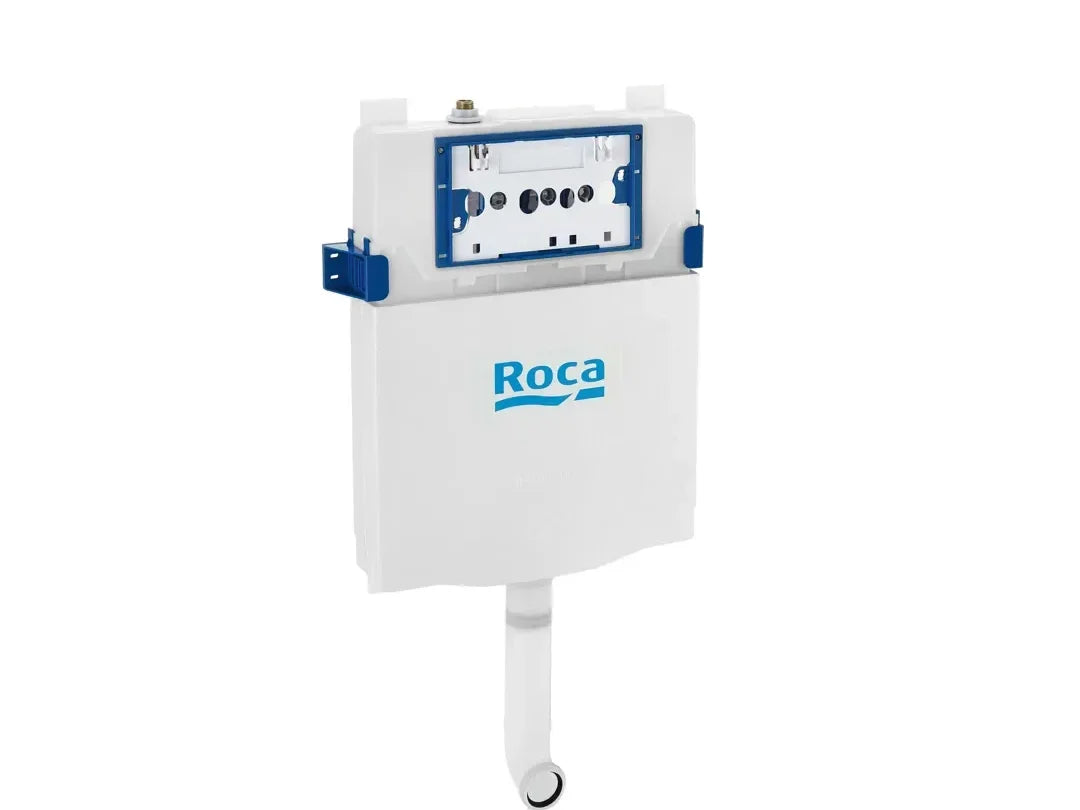
A concealed cistern is the flush tank hidden inside the wall, mounted on a metal frame, leaving only the flush plate visible. The frame is the structure that supports the cistern and, in the case of wall-hung toilets, the sanitary ware itself, distributing its weight onto the floor and the wall.
If you are renovating your bathroom and considering saving space and achieving a cleaner aesthetic, a concealed cistern is one of the decisions that most changes the final result. But it is also one that generates the most questions: brickwork or drywall, 8 or 12-centimeter depth, frame height, dual flush, maintenance… In this guide, we organize everything you need to know to make the right choice, using data taken from the actual product sheets in the Merkimarket concealed cistern catalog.
Key facts about concealed cisterns
- What it is: a flush tank hidden in the wall, mounted on a frame, with only the plate visible.
- Two mounting systems: for brickwork (embedded in a masonry wall) and for light walls or drywall (self-supporting frame).
- Common depths: 8 cm deep cisterns (such as Geberit Sigma type) for thin walls and 12 cm (such as Geberit Omega type) for greater water volume.
- Compatibility: there are models for wall-hung toilets and models for floor-mounted toilets.
- Flush: practically all incorporate dual flush (partial and full) to save water.
- Frame heights: from half-height versions (around 82 cm) to full frames for wall-hung units (around 112 cm).
- Catalog brands: Geberit, Roca, and Unisan, among others.
- Warranty: statutory minimum of three years for consumers in Spain, plus the seller's commercial warranty.
With this summary, you have the essentials; we will now develop each point so that you can make an informed decision.
Concealed cistern and frame: they are not the same
This is the most common confusion, so it is worth clarifying it first. The concealed cistern is the actual water tank, with its filling and flushing mechanism, which remains hidden in the wall. The frame (sometimes called a structure or support) is the metal framework that houses the cistern and secures it firmly to the floor and the partition.
The distinction matters for a practical reason: in a wall-hung toilet, the frame not only holds the cistern, but also supports the entire weight of the toilet and the person using it, as the toilet hangs from the wall without resting on the floor. That is why frames for wall-hung units are more robust and include the toilet anchor bolts. In a floor-mounted toilet, on the other hand, the sanitary ware rests on the floor and the concealed assembly is limited to hiding the cistern.

Types of concealed cisterns according to mounting
When choosing, the first question is not about aesthetics but masonry: what is the wall where it will be placed like? From there, the two major systems emerge.
For brickwork.
They are embedded inside a brick or block wall that is built or extended specifically. It is the classic solution in renovations involving wet construction. In the catalog, a system like Geberit Kombifix, designed for installation in masonry walls, follows this logic.For light walls or drywall.
Here, a self-supporting frame is used: a metal structure anchored to the floor and the wall onto which the plasterboard (drywall) is later screwed. It is the fastest and cleanest route, ideal when you do not want to build brick walls. Geberit Duofix is the reference example of a self-supporting frame, and brands like Unisan offer specific models for drywall such as the Quadro or the Sanfix.Within each system, another variable is the cistern depth, that is, how much it protrudes into the room. 8 cm deep models (for example, Geberit Sigma system cisterns) allow for thinner partitions and gaining centimeters in small bathrooms; 12 cm models (Omega system) offer a tank with more room. Choosing one or the other determines the thickness of the backing wall you will have to build.
Cisterns for wall-hung and floor-mounted toilets
The second major classification is according to the toilet you are going to hang from the assembly. If your project is a wall-hung toilet, you need a complete frame with toilet anchors; this is what most renovations seeking that floating, easy-to-clean-underneath look are after. If you are keeping a floor-mounted toilet but want to hide the cistern, there are specific concealed sets that hide the tank behind the toilet without the need for it to hang.
To decide between one toilet format or the other, our comparison of wall-hung vs. floor-mounted toilets will be useful, and if you are leaning towards the wall-hung version, it is worth reviewing the advantages and disadvantages of wall-hung toilets beforehand.

Dimensions and heights: what to check before you buy
This is where half the renovation headaches happen. A poorly sized frame forces you to redo the partition, so measure twice. These are the reference values that should be kept handy.
| Element | Reference value | Why it matters |
|---|---|---|
| Wall-hung frame height | Around 112 cm | This is the standard full height; it defines the vertical opening of the backing wall. |
| Half-height frame height | Around 82 cm | Useful when there is a window, beam, or shelf above. |
| Cistern depth | 8 cm or 12 cm | Determines how far the false wall protrudes into the bathroom. |
| Wall-hung toilet height | Adjustable, usually 40-45 cm from the floor | The frame allows for setting the seat height before closing the wall. |
| Flush plate width | According to system (Sigma, Omega…) | The plate must be compatible with the cistern system. |
A little-known advantage of a wall-hung toilet with a frame is precisely that you can choose the seat height before tiling: this is appreciated in homes with elderly or very tall people. Also remember to provide a water intake and the drain at the levels marked by the frame manufacturer.
How a concealed cistern is installed, step by step
Installation is plumber's work, but understanding the process helps you supervise the project and avoid surprises. Broadly speaking, these are the steps for a self-supporting frame for a wall-hung toilet:
- Layout. The position of the frame, the height of the toilet, and the water and drain levels are marked on the wall and floor.
- Anchoring the frame. The structure is fixed to the floor and the wall with its anchors, checking for level and plumb.
- Connections. The water inlet is coupled to the cistern and the drain sleeve to the stack, checking for leaks.
- Height adjustment. The studs and the seat height of the wall-hung toilet are adjusted.
- Closing the backing. Drywall is mounted or the masonry wall is built, leaving the plate opening accessible.
- Tiling and plate. After tiling, the toilet is hung and the flush plate is installed, which provides access to the mechanism.
It is essential to test for tightness before closing the wall: once tiled, any leak requires chipping. A good installer never covers a frame without having checked the flush and the joints.

Dual flush and water saving
Almost all current concealed cisterns incorporate dual flush: a large button for a full flush and a small one for a partial flush. The idea is simple and very effective: using only the water necessary in each case significantly reduces consumption throughout the year compared to an old single-flush cistern. Models like the Roca In Wall or the Unisan dual-flush system cisterns are designed specifically to optimize water use, which is reflected in both the bill and the bathroom's sustainability.
Maintenance: what if something inside the wall breaks?
This is the concern that holds many people back, and it has a reassuring answer. All maintenance for a quality concealed cistern is done through the flush plate: by removing it, you gain access to the flush mechanism and the shut-off valve, so changing a seal, the button, or the filling assembly does not require breaking the wall. That is why it is best to choose brands with long-term guaranteed spare parts — Geberit and Roca are references precisely for this — and save the system reference (Sigma, Omega, etc.) to order the correct part years later. The cistern itself, if well-installed, is a very durable element; what is replaced over time are the mechanism parts, all accessible from the outside.
Concealed cistern brands at Merkimarket
The catalog brings together the major references in the sector. Geberit is the leading manufacturer in concealed systems, with its Duofix (self-supporting for drywall) and Kombifix (for masonry) systems, and its Sigma (8 cm) and Omega (12 cm) cisterns. Roca provides compact dual-flush solutions like the In Wall, which are very practical when space is at a premium. And Unisan covers a wide range of cisterns and frames for drywall and masonry — Quadro, Sanfix, Sanflush, Sanbest — with a good quality-price ratio. You can see them all in the concealed cistern collection, or go directly to the Geberit Duofix Sigma concealed cistern for wall-hung toilets, one of the best-selling sets for drywall renovations.
How to choose your concealed cistern in 4 steps
- Decide on masonry or drywall. If you are building a wall, a system for masonry; if you want a quick and clean renovation, a self-supporting frame for drywall.
- Choose the type of toilet. Wall-hung for maximum cleanliness and floating aesthetics (requires a full frame) or floor-mounted with a concealed cistern.
- Check the dimensions. Frame height (112 cm or half-height), cistern depth (8 or 12 cm), and space available for the backing.
- Prioritize spare parts. Choose a brand with accessible spare parts and note the reference of the system and the plate. This is what will save you in ten years.
If you want to further refine your choice of sanitary ware, our guide on types of toilets, outlets, and dimensions complements this reading very well.
Frequently asked questions about concealed cisterns
What is the difference between a concealed cistern and a frame?
The concealed cistern is the water tank with its flushing mechanism that is hidden in the wall. The frame is the metal structure that holds that cistern and, for wall-hung toilets, the sanitary ware itself, transmitting its weight to the floor and the wall.
How high is a frame for a wall-hung toilet?
Full frames for wall-hung toilets are around 112 cm high, while half-height versions exist around 82 cm for when there is a window or an obstacle above. The toilet seat height is usually adjustable before closing the wall.
Can a concealed cistern be installed in a drywall partition?
Yes. For light walls or drywall, a self-supporting frame is used which is anchored to the floor and the wall; the plasterboard is then screwed onto this structure. Brands like Geberit (Duofix) or Unisan offer specific models for this installation.
How do you access the concealed cistern if there is a breakdown?
Through the flush plate. Removing it leads to the flush mechanism and the shut-off valve, so routine repairs do not require breaking the wall. It is advisable to choose brands with guaranteed spare parts and keep the system reference.
Article written by the Merkimarket editorial team. Technical data (systems, depths, dimensions, and compatibilities) taken from the product sheets in the Merkimarket concealed cistern catalog. The measurements are indicative; consult each sheet for the information currently in force in Spain.





